
AETHON Expert Advisor · XAUUSD · MT5
Aethon Flux
Two focused engines for trading gold
Aethon Flux combines two distinct gold-trading approaches in one MetaTrader 5 EA. Surge looks for breaks of the previous trading day's high and low. Vortex looks for opportunities as price approaches established hourly swing anchors. The engines address different price situations while sharing an emphasis on explicit trade management. For traders comparing premium XAUUSD systems, Flux offers a clear proposition: defined reference levels, separate entry logic and a hard stop-loss on every position.
This structure makes the product easier to understand than a collection of loosely described signals. A Surge trade begins with a daily boundary. A Vortex trade begins with an hourly anchor that has not yet been touched. Each has its own management settings and a reason for being in the system. Combining the engines creates more than one source of entries, although both still trade gold and can be affected by the same underlying market event. Two engines do not remove concentration in one instrument.
Surge watches the previous day's boundaries
The Surge engine uses the previous server day's high and low as breakout reference levels. It is designed to take one opportunity per side per day. When a level qualifies, the trade follows a defined stop and trailing framework. Using the broker's server day is an important practical detail because daily boundaries can differ between brokers. The relevant levels should be inspected on the account where the EA will run, rather than assumed to be identical across all terminals.
A breakout strategy accepts that some moves will fail. Price can cross a daily high and then fall back, or break a low before recovering. Flux addresses those situations through its order and exit rules, including a hard stop beyond the relevant level. Once a trade moves favourably, its trailing management can begin. The strategy's appeal lies in this complete sequence: identify the boundary, act under defined conditions and manage the exposure according to rules that are already in place.
Vortex approaches untouched swing anchors
Vortex uses a different kind of reference. Its documented swing anchors are hourly extremes identified over a window extending 24 hours on either side. The engine looks for untouched anchors and enters before price reaches the selected level. This makes it an approach-to-level strategy, with its own target and protection behaviour, rather than another copy of the daily breakout engine. The two components therefore have distinct entry explanations that can be checked against their respective trade comments and settings.
The anchor concept should be evaluated through the exact implementation and saved tests. A description of a swing level alone does not prove that an entry near it has an advantage. What matters is when the anchor becomes known, how the EA determines whether it remains untouched and how a position is managed after it opens. Flux gives those questions an identifiable framework. Its Vortex target and Protect feature add further rules to the lifecycle, including an attempt to retain a small gain after favourable movement.
Management begins with a hard stop
Every Flux position carries a hard stop-loss. Surge and Vortex use different stop settings because they trade different price situations. Their profit-management methods also differ: Surge uses trailing behaviour, while Vortex has its own target and protection logic. This separation lets a user inspect the engines individually instead of assuming a single exit rule suits both. It also provides a concrete basis for comparing the system with an EA that uses averaging or an open-ended recovery basket.
A hard stop is an instruction to the trading platform and broker, not a guarantee of an exact execution price under every condition. Fast moves, gaps and spreads can change the realised outcome. The useful benefit is that Flux defines an adverse exit for each trade from the outset. Account-level exposure still depends on trade volume and the number of concurrent positions. Those should be reviewed with the stop settings, especially when the balance-based sizing used in a test increases volume as the account grows.
Calendar controls and the weekly exit
Flux includes a blackout on NFP and Fed-decision days. In live operation, the documented calendar mode obtains relevant dates from MT5's economic calendar; the tester uses its built-in date handling. The aim is to restrict new entries around those scheduled events. This is a selective calendar control, not a claim that the EA avoids every announcement or every volatile period. Unexpected headlines and ordinary market movement can still affect open and future positions.
The documented weekly management also includes a Friday exit at 22:57. Users should check the relevant server-time interpretation and their broker's trading session before relying on a scheduled action. An exit near the weekly close can reduce intended weekend exposure, but execution still depends on the market being available. These details belong in the buying decision because a premium automation product should be assessed by its operational behaviour as well as by its entry signal and headline profit.
Results from the identified saved report
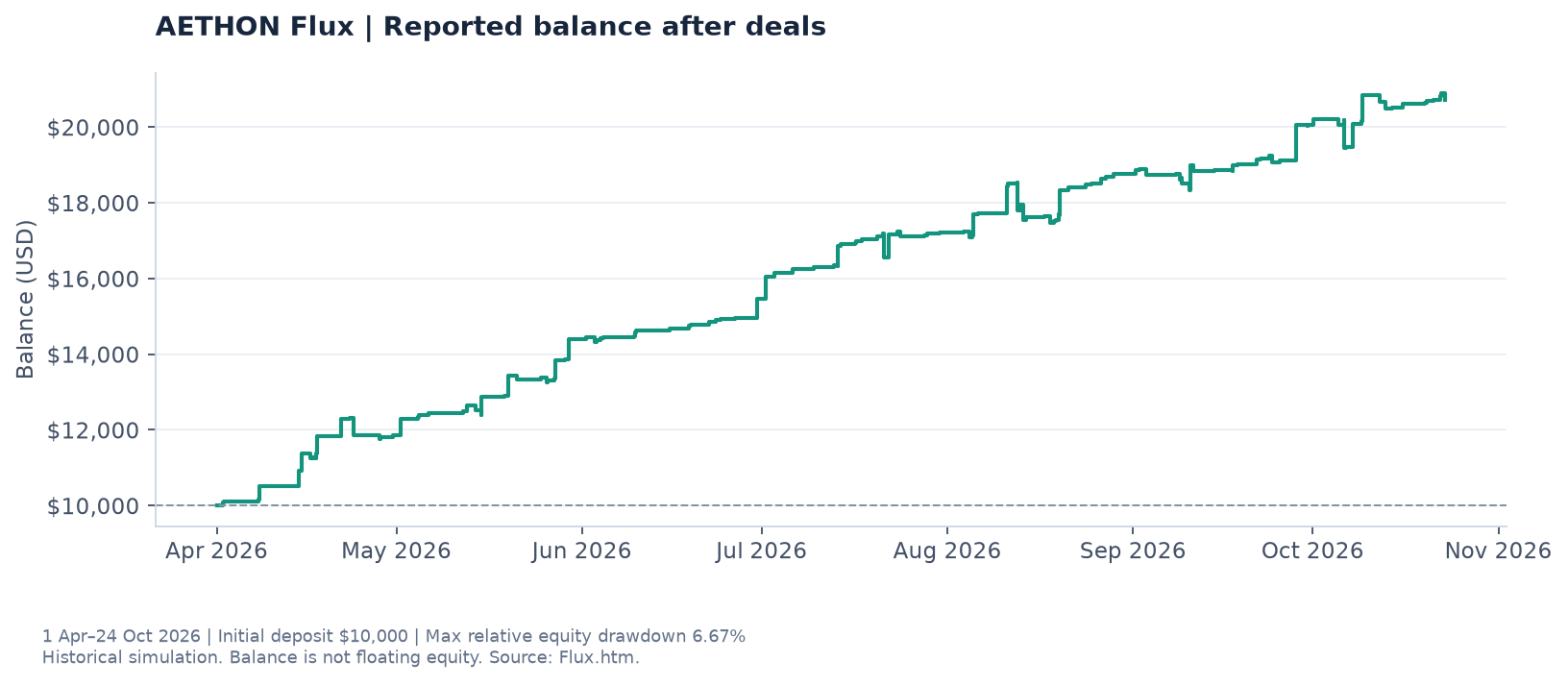
The reviewed Flux report covers XAUUSD from 1 April to 24 October 2026, with a $10,000 starting deposit. It records $10,706.28 net profit and a calculated ending balance of $20,706.28. That is a 107.06% arithmetic return on the initial deposit over the test period. The tester lists 163 trades, of which 138 were profitable, giving an 84.66% profitable-trade rate. Profit factor is 2.75, and the history-quality field reads 100% real ticks.
Maximum relative equity drawdown is 6.67%. The report separately records a largest cash equity drawdown of $1,230.19, with 6.58% attached to that event. Using the explicit relative-drawdown field avoids understating the deepest percentage decline. The two figures can differ because the largest dollar decline and the largest percentage decline need not occur at the same account size. Showing that distinction makes the performance evidence easier to interpret and avoids selecting whichever percentage happens to look smaller.
A shorter test offers useful context
A separately saved October test covers 1 to 24 October 2026 from a fresh $10,000 starting deposit. It records $316.80 net profit, a profit factor of 1.42 and 20 trades. Its profitable-trade rate is 75.00%, with 4.02% maximum relative equity drawdown. These figures are more modest than those of the longer test. They are included to show that the saved evidence contains variation across test windows, rather than one uniform rate of profit generation.
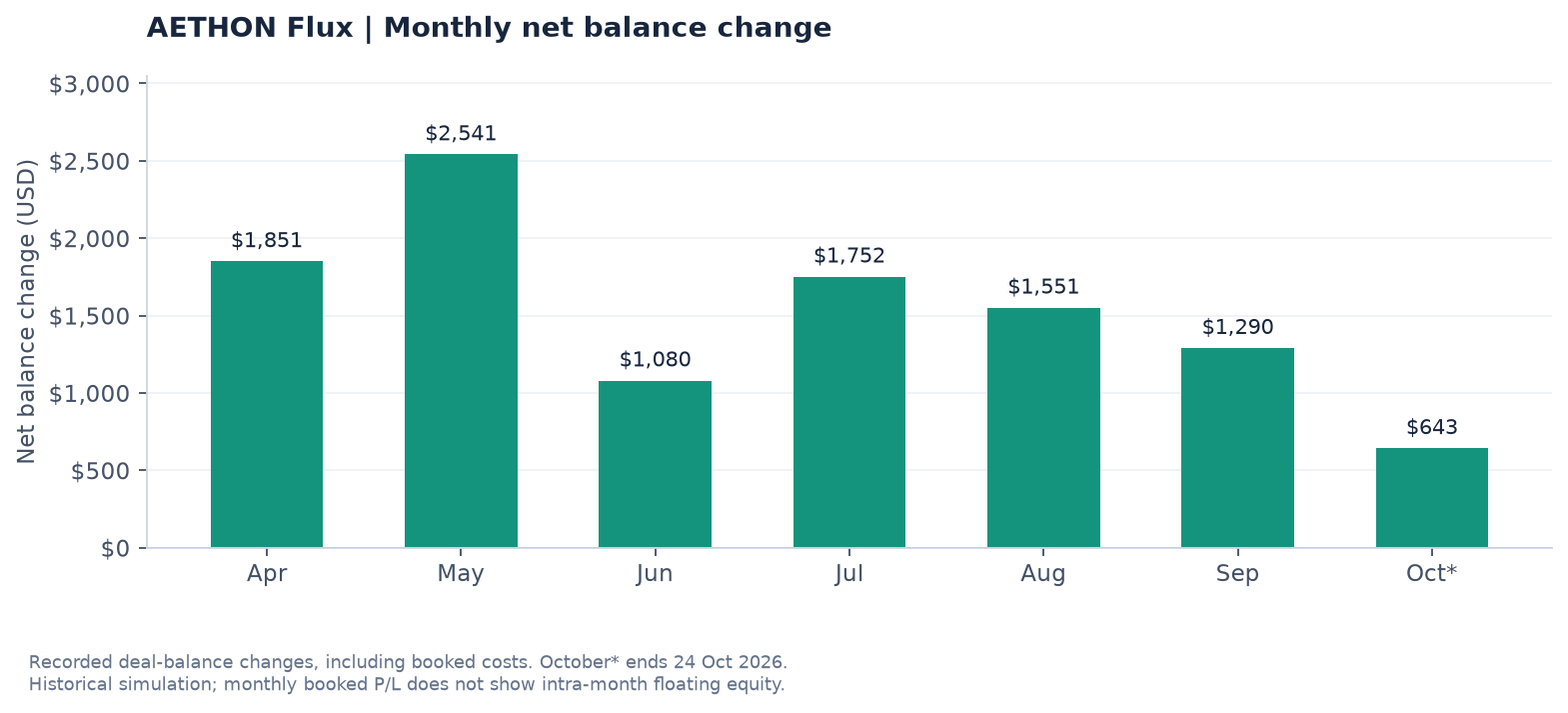
The October run is not presented as an independent forward test or a clean subtraction from the longer run. A fresh starting balance can change sizing, and the exact configurations must be considered before comparing outcomes. Its value here is as a separately identified simulation. The graphs retain its own label and period. The longer report remains the basis for Flux's main balance and monthly charts, so figures from different runs are not combined into an invented account history.
A defined alternative for the gold-trading shortlist
Flux will interest traders who want to evaluate level-based gold entries without relying on a single type of setup. Surge and Vortex provide two understandable starting points, while individual stops, calendar controls and profit-management rules define what happens around them. The saved main test combines a positive net result with a comparatively contained recorded relative equity decline. That combination gives a prospective buyer specific evidence to investigate, while remaining one historical simulation rather than a promise.
Review Flux through its complete report, engine settings and actual account requirements. Check the broker's symbol specification, daily boundaries and available calendar data before judging whether the implementation fits your trading setup. For a premium EA range, Flux's strongest case is the combination of distinct engines and traceable results. Its product page can present those strengths confidently while allowing visitors to see the shorter test, the losing trades and the drawdown figures that give the gains their proper context.
Saved report at a glance
| Starting deposit | $10,000.00 |
|---|---|
| Net profit | $10,706.28 |
| Return on initial deposit | 107.06% |
| Profit factor | 2.75 |
| Trades | 163 |
| Profitable trades | 84.66% |
| Maximum relative equity drawdown | 6.67% |
Historical simulation: 1 April–24 October 2026. History quality is labelled 100% real ticks in the report.
Interested in Aethon Flux?
Tell us your broker and account size. We'll reply with the price, the recommended settings and a licence key for your MT5 account number.