
AETHON Expert Advisor · GBPUSD · MT5
Aethon Prince
A dedicated GBPUSD breakout specialist
Aethon Prince is built around a specific market and a specific daily idea: define GBPUSD's early range, then act when price breaks beyond it. The EA combines that entry with staged position management, reserve additions and individual hard stops. For traders who want a premium forex specialist alongside gold systems, Prince provides a clearly described alternative. Its logic can be followed from the range calculation through the initial entry and into the management of every position leg.
This focus makes Prince easier to assess against a trading preference. It is a range-breakout system for GBPUSD, rather than a claim to trade every instrument under every condition. Its timing, stop distance and reserve behaviour are part of one design. A prospective buyer can inspect those mechanics and the associated tester report together. That is a more useful basis for choosing an EA than relying on a high winning percentage without understanding how losing exposure is handled.
The dawn range establishes the daily setup
The reviewed strategy measures the high and low between 03:00 and 11:00 server time. At 11:00, it arms hidden breakout levels on both sides of that range. The first side to break becomes the day's initial direction. This creates a repeatable sequence with a known range-building period and a known point at which the system begins looking for a breakout. Because the clock is server-based, the intended broker schedule should be checked before interpreting the trading window.
Range breakouts can produce both continuation and failure. A move beyond the boundary may accelerate, stall or reverse back into the range. Prince does not leave the response to an undefined recovery promise. Its position structure, trailing rules and staged reserves describe how the system reacts after entry. Understanding those later stages is important because the entry is only the start of the exposure. The range offers the reference level; the rest of the strategy determines how the account experiences the outcome.
Each entry becomes a five-leg Squad
Prince splits the initial trade into five legs, collectively called a Squad. Managing the legs separately gives the EA a framework for trailing, closing and allocating later actions. The number of reported trades therefore needs context: several trades may arise from one initial breakout decision. A count of 587 trades does not mean the system observed 587 unrelated daily setups. Buyers should read activity figures with the structure of the strategy in mind.
Each leg carries a hard stop-loss. That is an important feature, but the total exposure still depends on the combined volume of the Squad and any reserve positions. A trader comparing Prince with a single-position breakout EA should compare the complete trade group rather than one leg in isolation. Position splitting changes how management is organised; it does not by itself make the underlying directional exposure disappear. The saved report gives the account-level outcome needed to assess the full structure.
Escort trails the initial legs
Escort applies a tight trailing framework to the Squad legs. When the breakout develops favourably, the system can move stops according to the configured gap and step. This lets Prince manage a paying move without requiring the user to adjust each position manually. The design combines an automated daily entry process with automated management after entry, which can be useful for traders who prefer a defined schedule but cannot monitor every short-term movement once the positions are open.
A tight trailing rule involves a trade-off. It may retain part of a move that later reverses, and it may also close a position before a larger move develops. The correct balance depends on the method being tested. Prince's report reflects the complete saved configuration, including its management behaviour, rather than a theoretical breakout entry without exits. That is why the product page shows net results and drawdown, not a count of price moves that crossed the original range.
Reserves respond to failed breakouts
Prince contains two staged reserve additions if the breakout moves against the original position. Each addition changes the shared target, bringing it closer under the documented logic. Shield adds a profit-locking rule associated with the second reserve. This means Prince should be described openly as a system that can add exposure during an adverse move. The presence of hard stops distinguishes its management from an unlimited no-stop basket, but it does not remove the risk associated with adding positions.
Reserve behaviour deserves particular attention when reviewing account size and margin. The initial Squad is only one possible stage of the trade lifecycle. A user should understand the potential volume after reserve stages activate and how the shared exit relates to the individual stops. A product description that presents Prince only as a simple breakout would leave out a material part of its strategy. The full design includes both following a successful break and managing a break that does not immediately work.
Treasury allocates part of winning closes
Treasury uses a share of winning closes to retire losing legs one by one. It is an internal management rule for handling existing exposure, not a source of profit outside the trading strategy. The mechanism is useful to explain because a high proportion of profitable closes can coexist with losing positions that remain open for a time. Treasury changes the way the system manages those positions, and its effect should be judged in the complete account record.
No accounting rule can make the economic cost of a losing position vanish. Realising a winner and closing part of a loser changes the open and booked components of the account, while the overall result still reflects both. Prince's appeal is that the process is defined and automated. Its suitability depends on whether the resulting pattern of exposure fits the user's objectives. The equity-drawdown field helps reveal what happened beyond the sequence of completed winning trades.
The main saved test
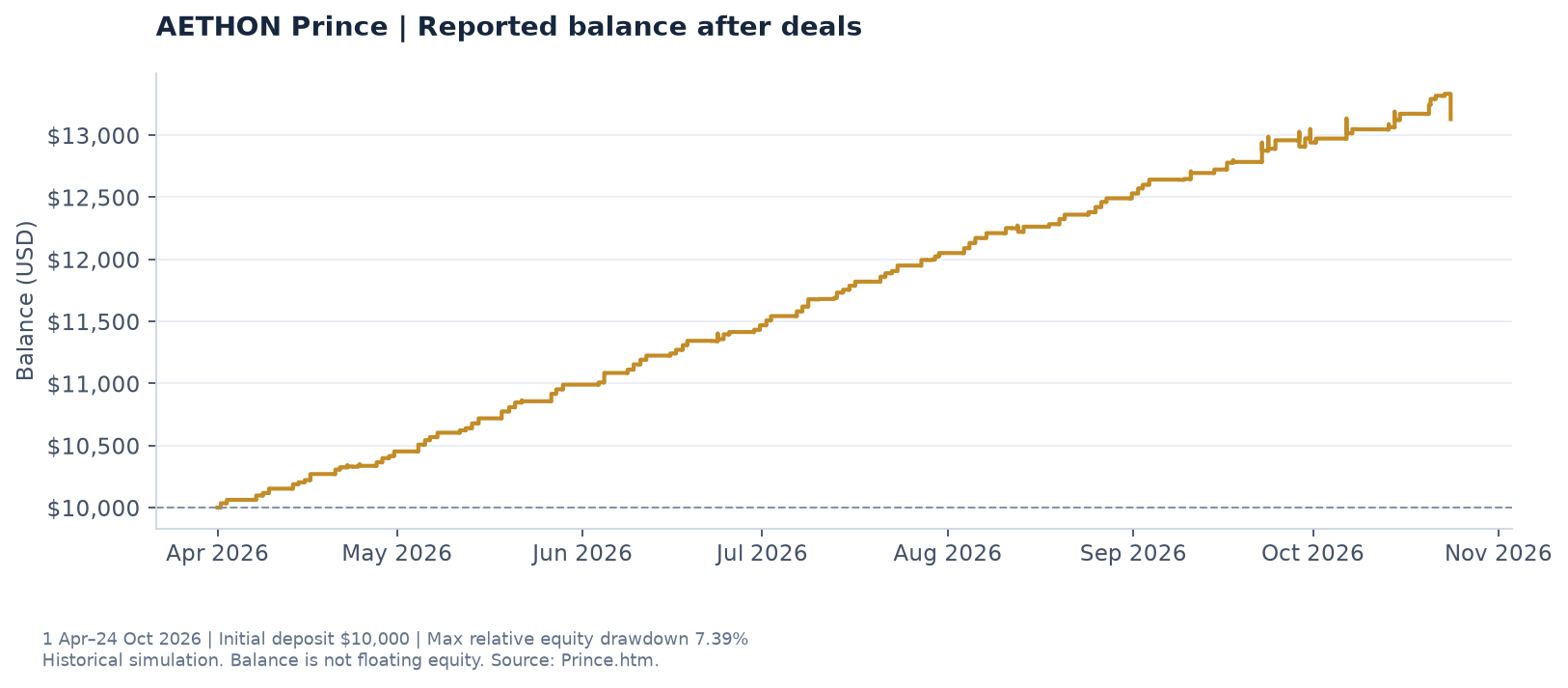
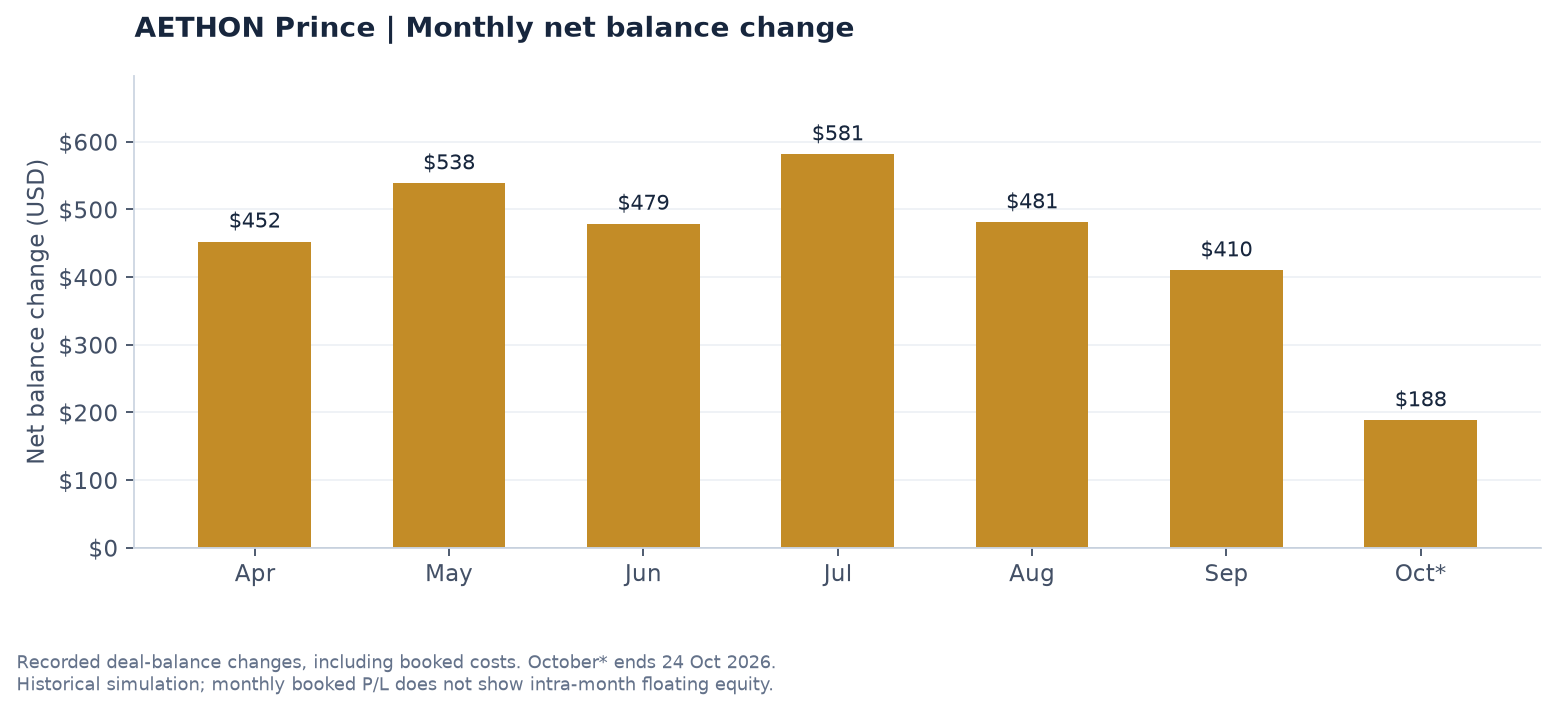
The identified comparison report covers GBPUSD from 1 April to 24 October 2026, using an M15 tester period and a $10,000 starting deposit. It records $3,129.03 net profit, a calculated ending balance of $13,129.03 and a 31.29% arithmetic return on the starting deposit. Profit factor is 3.67. Across 587 reported trades, 93.36% were profitable. The history-quality label is 100% real ticks. These figures belong to this specific saved report and configuration.
Maximum relative equity drawdown is 7.39%, compared with 1.53% relative balance drawdown. The larger equity figure captures the importance of open exposure. The high winning percentage is a favourable historical observation, but it does not establish that future trades will maintain the same distribution. Multiple legs and staged management also mean the trades are not necessarily independent observations. The performance should therefore be read as a complete simulation, with the profit, activity and equity decline displayed together.
Additional context from an October run
A separate saved test from 1 to 24 October 2026 records $177.72 net profit from a fresh $10,000 deposit. It lists 61 trades, an 80.33% profitable-trade rate, a profit factor of 1.69 and 3.67% maximum relative equity drawdown. That shorter run is less profitable than the main test on a percentage basis. Including it gives visitors a broader view of the saved evidence and avoids implying that Prince produced the same rate of gains in every part of the period.
The October report is not labelled as an independently established forward test. It is a separate historical simulation with its own starting conditions. Likewise, its result should not simply be subtracted from the longer test to invent a missing period. The main balance graph and monthly bars use the identified comparison report throughout. A different earlier parity report records a slightly different net profit, so those values are kept separate rather than blended into one attractive but untraceable set of statistics.
A focused choice for systematic forex traders
Prince offers a distinctive combination of a scheduled GBPUSD breakout, five-leg position management and planned responses to both favourable and adverse movement. Those are concrete reasons to consider it in a premium EA shortlist. The saved report adds a positive historical result with a clearly recorded equity decline. Customers can evaluate that evidence against the actual management structure, including the reserves and Treasury mechanism, rather than relying on a simplified description of the opening signal.
Review the range timing, complete exposure and saved inputs before choosing a configuration. Check the broker's server clock, contract specification and execution conditions on the intended account. Prince's strongest product story is a clearly defined process supported by traceable results. It is built for traders who value a dedicated GBPUSD method and want to understand how their EA handles a full trading day, from the initial range through the final management of open legs.
Saved report at a glance
| Starting deposit | $10,000.00 |
|---|---|
| Net profit | $3,129.03 |
| Return on initial deposit | 31.29% |
| Profit factor | 3.67 |
| Trades | 587 |
| Profitable trades | 93.36% |
| Maximum relative equity drawdown | 7.39% |
Historical simulation: 1 April–24 October 2026. History quality is labelled 100% real ticks in the report.
Interested in Aethon Prince?
Tell us your broker and account size. We'll reply with the price, the recommended settings and a licence key for your MT5 account number.