
AETHON Expert Advisor · XAUUSD · MT5
Aethon Pulse
Three engines built around gold's range boundaries
Aethon Pulse gives XAUUSD traders a multi-engine breakout system with clearly defined reference levels. Every four hours, the EA refreshes its anchors around the outer edges of a recent M15 trading range. Three independent engines then use those boundaries in different ways: Swift targets shorter moves, Stride seeks a more extended outcome, and Tempo adds a market-regime filter. For traders comparing premium gold EAs, Pulse offers a specific combination of entry structure and individual position controls.
The design avoids grid averaging and martingale sizing. Each trade carries a hard stop-loss and take-profit from entry, with a separate Protect feature that can move the stop after favourable movement. That makes Pulse a defined alternative to basket-recovery systems. Its multi-engine structure still creates shared exposure to gold, so users should evaluate the account-level result rather than assume that three engines automatically diversify risk. The practical question is how those engines behave together under the same market conditions.
Anchors turn the recent range into reference levels
Pulse derives its anchors from the highest high and lowest low within the configured M15 window. The reviewed source default is 1,500 bars. These boundaries give the EA explicit levels at which to prepare breakout orders. Refreshing them on a four-hour schedule creates a repeated evaluation cycle while allowing the underlying range to change as new data arrives. The number of historical bars is configurable, so it should not be treated as a guarantee that every installed setup uses the same range.
A range boundary is a reference, not a promise of continuation. Price can trigger a stop order and then reverse. The strength of Pulse's explanation is that each engine has defined instructions for that situation, including its stop-loss and target. The saved backtest records the combined effect of those instructions. A buyer can therefore connect the strategy description to actual trades, rather than judging the EA from a chart showing only the breakouts that happened to continue favourably.
Swift takes the shorter-target approach
Swift is the shorter-target breakout engine. The reviewed configuration permits two orders per side and exposes its own stop, target, stacked-order volume factor and order lifetime. Those settings define how Swift participates when price reaches an anchor. A shorter target changes the distance the trade needs to travel, but it does not mean the trade is automatically safer. The relationship between stop distance, target distance and position size remains central to the outcome.
The possibility of more than one order per side also matters when assessing exposure. Two trades triggered near the same boundary can respond to the same reversal. Users should inspect their combined volume and the effect of their exits together. The value of the separate engine is that its behaviour can be described and examined independently, while its contribution to the complete system remains visible in the account-level report. Swift is one component of Pulse, not a separate performance promise.
Stride gives a breakout more room to develop
Stride uses a longer-target approach and, in the reviewed settings, allows one order per side. It has its own stop percentage, target percentage and order lifetime. This gives the system a different exit horizon from Swift's. The design can therefore respond to the same general range structure with trades seeking different outcomes. A longer target also brings different demands: the position may remain open longer, encounter more retracement or fail before the intended move develops.
That is why Stride's role should be evaluated through its complete rule set rather than the size of its target alone. A large target is an instruction, not evidence that price frequently reaches it. The engine's trade volume, stop distance and interaction with Protect all affect the final result. Pulse's product page can explain the distinction confidently without assuming that a longer horizon is inherently better. It is a deliberate part of the design that requires its own evidence.
Tempo adds a regime qualification
Tempo is the regime-filtered breakout component. The source exposes conditions related to volatility rank, distance from reference levels and directional drift. Those inputs give it an additional qualification layer before participating. The reviewed configuration permits two orders per side, with a separate volume factor for its stacked order. Tempo therefore differs from Swift through more than its name: its filter and settings change the circumstances under which it contributes to the complete system.
A regime filter can exclude trades under specified conditions, but it does not guarantee that the remaining conditions are profitable. Its value is that the decision process is explicit. A trader can investigate which environments the filter allowed, what happened afterward and whether those relationships persist in additional testing. Since all three engines trade XAUUSD, a market event can still affect them together. Their different rules create different entry and exit paths within a common instrument, rather than eliminating common exposure.
Stops, targets and Protect
Every Pulse trade starts with its own hard stop-loss and take-profit. Protect can move the stop to retain a small gain after the position reaches its configured favourable threshold. The source settings express several distances as percentages of price, with separate values for the engines. This makes the relationship between price level and distance part of the strategy. Users should review those units carefully rather than interpret each number as a fixed dollar amount or a percentage of account equity.
The distinction between price percentage and account risk is important. A stop placed a certain percentage away from gold's price does not by itself state the percentage of account capital at risk. That depends on position size and the broker's contract specification. A user should therefore assess stops and sizing together. Protect also remains subject to order modification and execution conditions; the intended locked amount can differ from the realised net outcome after costs, slippage or a gap.
The identified backtest result
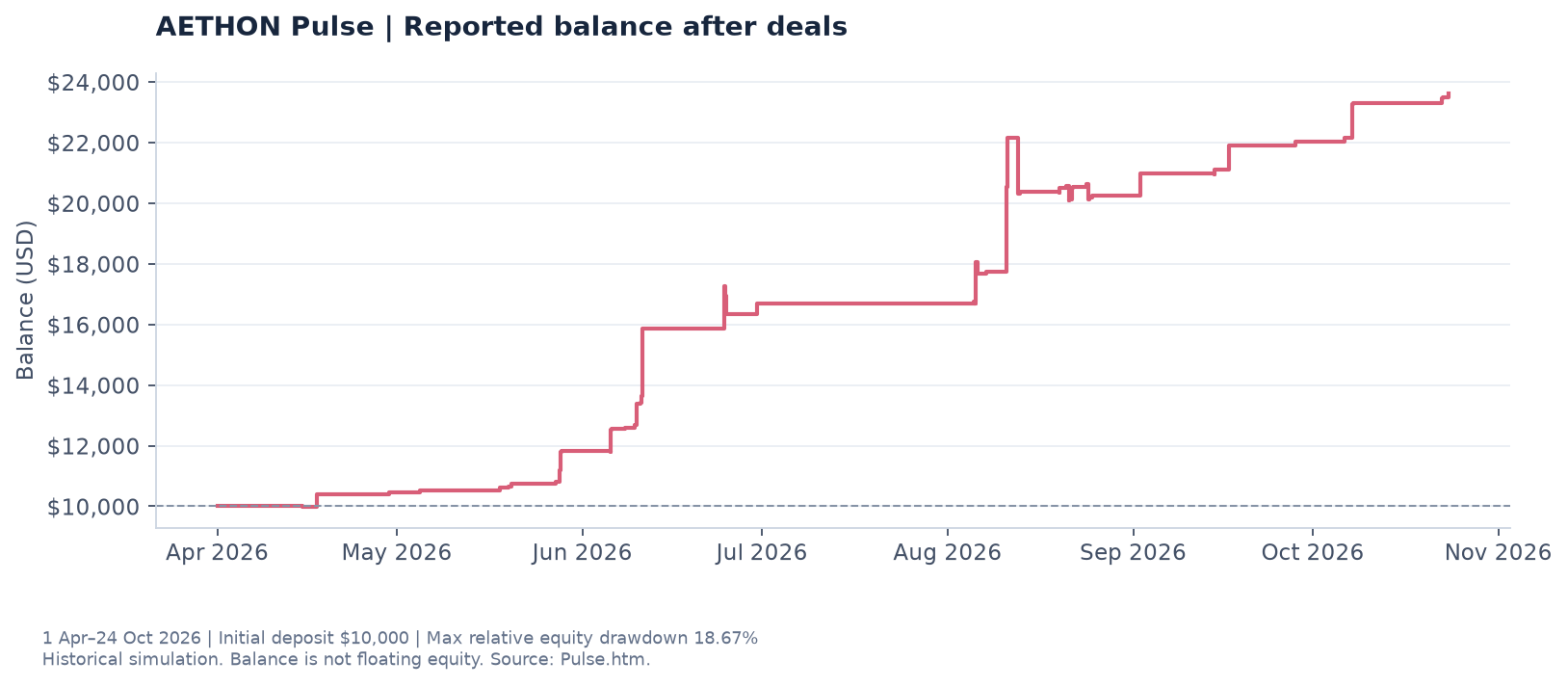
Pulse's saved comparison report covers 1 April to 24 October 2026 on XAUUSD, starting from $10,000. It records $13,611.21 net profit and a calculated ending balance of $23,611.21. The arithmetic return over the stated period is 136.11%. The tester lists 159 trades and a 92.45% profitable-trade rate. Profit factor is 4.19, and the history-quality field reads 100% real ticks. These statistics refer to the identified report and should remain attached to its exact test period.
Maximum relative equity drawdown is 18.67%, while relative balance drawdown is 9.27%. The reported largest cash equity drawdown is $4,174.03. Showing both the return and the equity decline makes the historical trade-off easier to judge. A 92.45% profitable-trade rate does not remove the importance of the remaining losing trades, nor does it describe the size of their losses. Profit factor and drawdown add context that a winning percentage cannot provide by itself.
What the graphs show
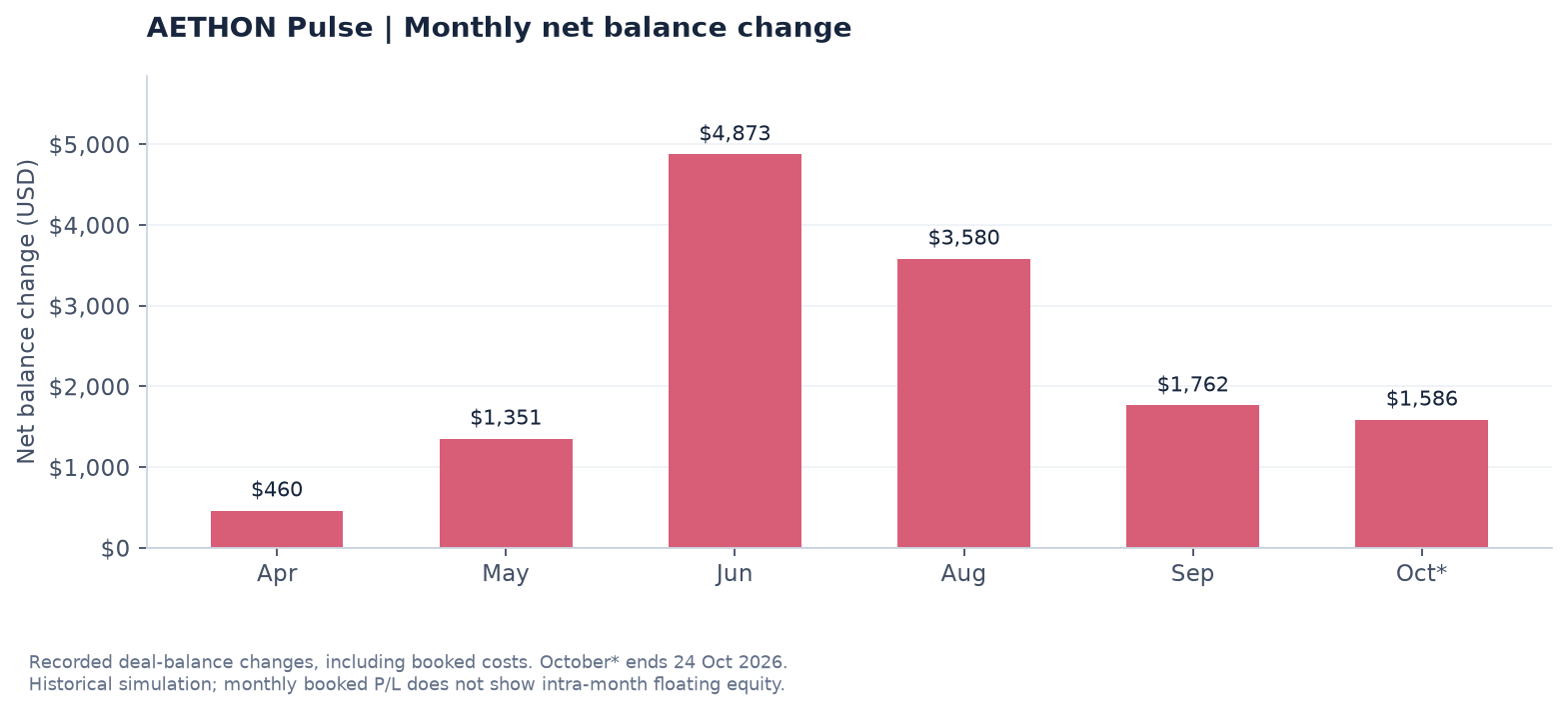
Pulse's balance chart is reconstructed from the deal-history balance values in its saved report. The monthly chart groups the resulting changes in balance by calendar month. Both reflect the recorded trading costs present in that account history. Neither chart reconstructs the complete path of unrealised profit and loss while positions remain open. For that reason, the equity-drawdown statistic stays visible beside the performance figures, even when the balance line looks smoother than the experience of holding the positions.
The graphs cover the actual saved test span, with October ending on 24 October. They do not extend the result into a full year or imply that the same return would repeat. Sizing settings can also change how gains and losses accumulate as the account grows. A comparison between Pulse and another EA is therefore a comparison of identified saved runs, not a controlled proof that one engine or product is superior under every possible risk setting.
A substantial option for a gold EA shortlist
Pulse will interest traders who want defined breakout levels, several exit horizons and individual hard stops. Swift, Stride and Tempo give the strategy a clear internal structure, while Protect provides a further management rule after entry. Its saved report records a strong positive outcome alongside an equity decline that needs to be understood. Those are concrete grounds for investigating the system in detail and comparing it with other gold EAs using the same care over settings and exposure.
Explore Pulse through the engine rules, exact inputs and complete test evidence together. Confirm the broker's symbol specification, spread conditions and permitted order behaviour before judging the fit for a particular account. Pulse's premium proposition is a focused gold breakout framework supported by traceable historical results. A buyer should be able to understand where the orders come from, how they are managed and what the account experienced in the saved simulation before deciding whether the product belongs in their trading setup.
Saved report at a glance
| Starting deposit | $10,000.00 |
|---|---|
| Net profit | $13,611.21 |
| Return on initial deposit | 136.11% |
| Profit factor | 4.19 |
| Trades | 159 |
| Profitable trades | 92.45% |
| Maximum relative equity drawdown | 18.67% |
Historical simulation: 1 April–24 October 2026. History quality is labelled 100% real ticks in the report.
Interested in Aethon Pulse?
Tell us your broker and account size. We'll reply with the price, the recommended settings and a licence key for your MT5 account number.