
AETHON Expert Advisor · XAUUSD · MT5
Aethon Virtue
A structured approach to gold pullbacks
Aethon Virtue brings six independent session modules to automated gold trading on MetaTrader 5. Its strategy looks for mean-reversion opportunities through a combination of timing, volatility checks and entry confirmation. Each module operates on its own timeframe and within its own window. For experienced traders interested in basket systems, Virtue offers a detailed framework that can be inspected module by module, rather than an undefined promise that every dip or rally will eventually reverse.
The system is designed for XAUUSD. Its entries depend on a volatility ceiling, an RSI band and a pullback bar. Those conditions give the first position in a basket a specific basis. Subsequent management uses equal-sized additions at volatility-based distances, with the basket seeking a shared exit. This makes Virtue a specialist product for traders who understand both the attraction and the risk of averaging. Its technical structure deserves attention, and its substantial recorded equity drawdown deserves equal visibility.
Six modules with distinct schedules
Virtue's six modules can be considered separate entry components within a common basket-management framework. Each has a defined trading window and timeframe, allowing the system to evaluate opportunities under different timing conditions. Module switches provide a way to enable or disable components. That can help a user study where trades originate, although changing the active set creates a different configuration whose results should be evaluated separately. The saved report cannot establish the performance of every possible combination.
This modular structure is useful for understanding the EA's behaviour. A trader can ask which session opened a basket, what volatility was present and which RSI conditions qualified. Those questions are more informative than looking only at the final balance. They also help distinguish a disagreement with the strategy from a setup problem. If the EA takes a trade that follows its documented conditions, the issue may be the suitability of those conditions, rather than an execution fault.
Entry filters put conditions around the first trade
The volatility ceiling is intended to limit entries when measured volatility exceeds the configured threshold. The RSI band adds a momentum-related condition, while the pullback bar adds a price-action requirement. All three form part of the initial entry framework. Their role is to define when a basket may begin, not to guarantee that price will return quickly once the basket is open. A qualifying entry can still be followed by a sustained move against the position.
For a buyer, the benefit of explicit filters is that the strategy can be reviewed with concrete questions. How often did each filter allow an entry? What happened when volatility expanded after the basket opened? How long did positions remain exposed? The existing backtest answers some outcome questions, but it does not eliminate uncertainty about future market conditions. Virtue's product description should therefore explain the filters in practical terms and let the report show how their combined behaviour played out historically.
Equal-lot additions and ATR-based spacing
Virtue averages adverse moves with equal-sized positions. Its grid spacing is linked to Average True Range, with a minimum distance and an expansion factor for later additions. The reviewed source defaults include a maximum of six legs per basket and a spacing expansion factor of 1.70. These details establish boundaries around the addition process. They also distinguish the design from a martingale that increases the size of each successive leg to recover losses more aggressively.
Equal sizing does not mean constant total risk. As positions are added, the combined volume rises, and the account may carry a larger floating loss. Wider spacing can change the timing of those additions without imposing a fixed maximum loss on the basket. This is why the number of allowed legs should be read together with position size and the absence of a stop-loss. A grid with a leg limit can still experience an adverse move large enough to put the account under severe pressure.
One target for the basket
Virtue's exit framework uses the volume-weighted average entry price plus a volatility-scaled target. This means it evaluates the positions as a group, rather than requiring every leg to be individually profitable before closing the basket. The target changes with the basket's structure and the relevant volatility settings. For a trader accustomed to independent stop-and-target positions, this is a different management model and should be understood before deciding whether the EA fits the account's purpose.
An optional trailing exit can be armed at the normal basket target. Its settings allow the basket to continue participating in a favourable move and seek an exit after a retracement. The reviewed source also contains minimum-distance and floor settings. These features describe the intended software behaviour once the trail is armed; they do not guarantee a particular fill during fast markets. The saved test's exact inputs remain the proper reference when linking any management feature to a historical performance claim.
The saved test results
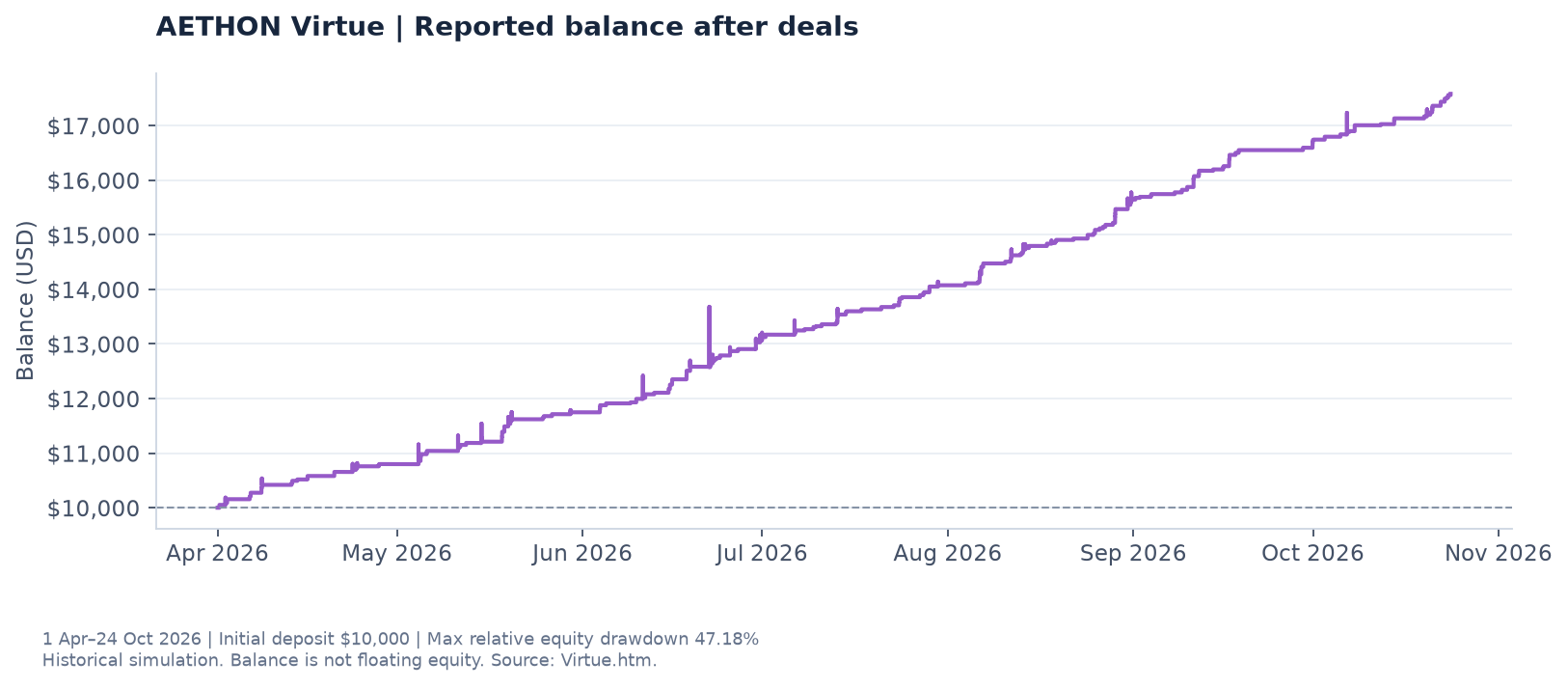
The identified Virtue report covers XAUUSD from 1 April to 24 October 2026. Starting from $10,000, it records $7,582.48 net profit, producing a calculated ending balance of $17,582.48. The arithmetic return on the starting deposit is 75.82%. The report lists 266 trades and an 84.96% profitable-trade rate, with a profit factor of 2.32. History quality is labelled 100% real ticks. These figures describe one saved historical simulation and its particular settings.
The risk figures are essential to interpreting that positive result. Maximum relative equity drawdown was 47.18%, with a reported largest cash equity drawdown of $5,947.14. Relative balance drawdown was much smaller at 8.08%. The gap between the equity and balance percentages shows why an attractive record of completed trades can provide an incomplete account of a basket system. Open positions can experience substantial losses before their eventual closure, and the account must carry that exposure while it remains open.
Why the equity figure belongs beside the profit
A visitor seeing a 75.82% simulated gain should also see the 47.18% maximum relative equity drawdown. Presenting both makes the trade-off visible. The report does not support describing Virtue as low risk, capital protected or suitable for every account. It supports describing a positive historical result accompanied by a deep equity decline. Experienced basket traders can evaluate that combination against their own requirements, without having the most important risk measure hidden behind a separate technical link.
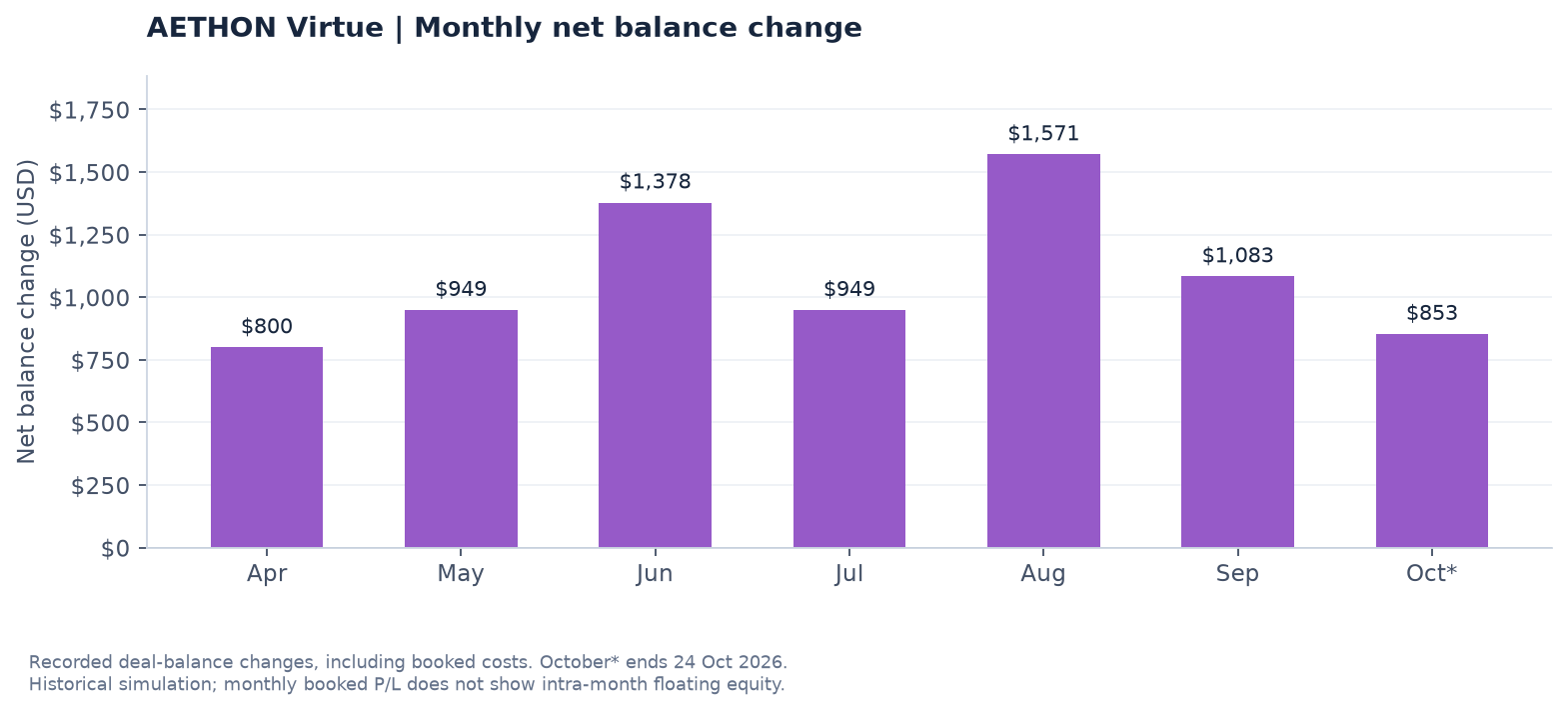
The accompanying balance chart is reconstructed from the report's deal balances. It should not be mistaken for a continuous equity chart. Its monthly bars show changes in booked balance, including recorded costs, and can help identify how the simulated gains were distributed. They cannot show every floating loss within a month. This is why the equity-drawdown statistic remains displayed next to the graph, even when the balance line appears comparatively orderly over part of the test.
Who should examine Virtue
Virtue is best considered by traders who already understand averaging, combined basket exposure and the possibility of long adverse moves. Its six-module structure, explicit entry filters and volatility-based spacing provide several technical reasons to investigate it. Those features make it a substantial specialist EA, but they do not change the underlying no-stop-loss design. The reviewed source states that baskets can lose the entire account balance. That risk is part of the product's operating model and belongs in a considered buying decision.
Explore Virtue by reviewing the basket rules, saved inputs and complete tester evidence together. Confirm the account mode and broker requirements for the build being offered, then assess a configuration on its own merits. Virtue's strongest sales presentation is specific about what it does: selective session entries, equal-lot averaging and coordinated exits on gold. Its credibility comes from giving customers enough information to judge those mechanics, including the substantial historical exposure that accompanied the recorded profit.
Saved report at a glance
| Starting deposit | $10,000.00 |
|---|---|
| Net profit | $7,582.48 |
| Return on initial deposit | 75.82% |
| Profit factor | 2.32 |
| Trades | 266 |
| Profitable trades | 84.96% |
| Maximum relative equity drawdown | 47.18% |
Historical simulation: 1 April–24 October 2026. History quality is labelled 100% real ticks in the report.
Interested in Aethon Virtue?
Tell us your broker and account size. We'll reply with the price, the recommended settings and a licence key for your MT5 account number.