
Market sessions8 min read
Best time to trade gold (XAU/USD): session by session
Gold moves differently in Asia, London and New York. How each session compares, so you can pick the hours that fit your strategy.

The best time to trade gold depends on your strategy, because XAU/USD is not equally active all day. Gold tends to move most when London and New York are both open, moves less steadily in Asia, and can be very quiet, with wider spreads, late at night. If you match your session to your strategy, you give your plan a fair test.
Best time to trade gold at a glance
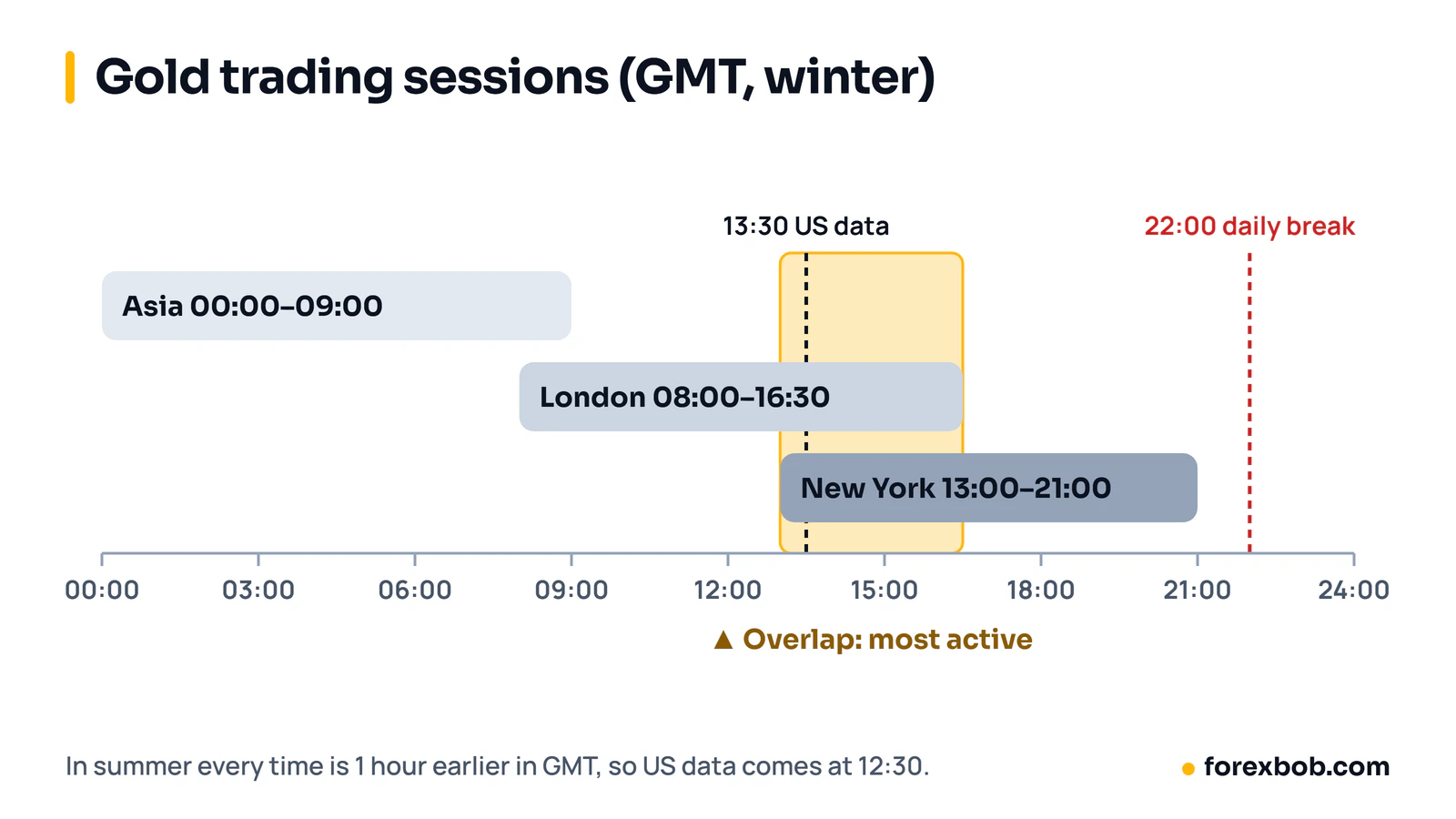
For most short-term traders, the most active window is the London–New York overlap: roughly 08:00 to 11:30 New York time. That is about 13:00 to 16:30 GMT in winter; in summer, when the UK and the US are both on daylight saving, it is an hour earlier in GMT, about 12:00 to 15:30. The London morning before the overlap is usually the next most active period. Asia is normally quieter, and the hours after New York closes are normally the quietest of all.
Those times are guides, not exchange opening bells. Spot gold trades over the counter through brokers, so exact hours vary from broker to broker. London and New York together bring the most orders and usually the tightest spreads, while quiet hours bring less movement and often wider spreads. Your strategy decides which window fits best: a breakout trader usually wants the overlap, while a range trader may prefer slower parts of Asia or early London. Our guide to the forex trading sessions explains the same pattern for currency pairs.
Asia, London and New York, session by session
Asia: slow, steady and often range-bound
The Asian session runs roughly from 00:00 to 09:00 GMT, which is 19:00 to 04:00 New York time in winter and 20:00 to 05:00 in summer (Tokyo does not change its clocks). Tokyo is the main centre, with Sydney opening earlier. Gold often drifts or stays in a range in Asia, because the large European and US order flow has not yet arrived.
Range traders may find cleaner highs and lows here, while breakout traders often find that breaks fail and price returns inside the range. We tested this on gold from 2017 to 2026: over 1,500 breaks of the Asian range during the London session made close to nothing on average. Spreads can also be wider than in London or New York, so check the spread before you enter. If you are new to gold, start with our guide to trading gold (XAU/USD).
London: the morning build-up
The London session runs roughly from 08:00 to 16:30 London time: 08:00 to 16:30 GMT in winter and 07:00 to 15:30 GMT in summer. In New York time, that is about 03:00 to 11:30 all year. Activity usually builds through the morning as European traders arrive and European data is released.
The London open itself can be jumpy, with price spiking one way and then reversing as early orders settle. Some traders wait 30 to 60 minutes after the open to see whether the early move holds. Others trade the open with a wider stop and a smaller size to allow for that noise.
New York: US data, the dollar and the afternoon fade
The New York session runs roughly from 08:00 to 16:00 New York time: 13:00 to 21:00 GMT in winter and 12:00 to 20:00 GMT in summer. New York brings US economic data, US stock market hours and the strongest link between gold and the US dollar. When the dollar rises sharply, gold often falls, and the other way round, although the link is not exact.
Activity in New York is often strongest in the morning, when data is released and London is still open. It then fades in the afternoon after London closes, with lower volume and less follow-through.
The London–New York overlap
The overlap is when London and New York are both active. It combines European and US order flow, so gold often makes its largest and cleanest moves of the day in this window. Breakouts are more likely to follow through, trends are more likely to hold, and spreads are usually at their tightest. For a trader with a momentum or trend plan, this is usually the best time to trade gold.
The extra movement has a cost. Stops placed too close are hit more often, and a position can move against you faster than in Asia, so set the stop beyond normal noise and keep your usual size. The overlap also contains the scheduled US releases, so a trend can reverse in minutes on an inflation or jobs report. Many traders avoid new entries just before major releases, or trade smaller around them.
News releases, the daily break and rollover
US data releases are the main news risk for gold. Reports such as US inflation, the jobs report, Federal Reserve decisions and retail sales can move XAU/USD by several dollars in minutes. A $5 move is worth $500 on a standard lot, because 1 lot is 100 ounces and $5 × 100 = $500. That is why news trading needs a plan for size, stop distance and slippage. For a fuller checklist, read our guide to trading around news releases.
A few practical rules help. Check the economic calendar before the session, note each release time in your own time zone, and decide in advance whether you will be flat, smaller or normally sized through it. Do not enter just before a major release unless your plan covers that case, with a stop you accept could slip, because spreads often widen and fills can slip.
The daily break needs attention too. Many brokers pause gold trading for about an hour at 17:00 New York time (22:00 GMT in winter, 21:00 GMT in summer) for settlement and rollover, and positions held overnight may pay or receive swap charges that vary by broker and direction. Check your broker's break time and swap rates before holding gold overnight.
Sizing gold positions correctly
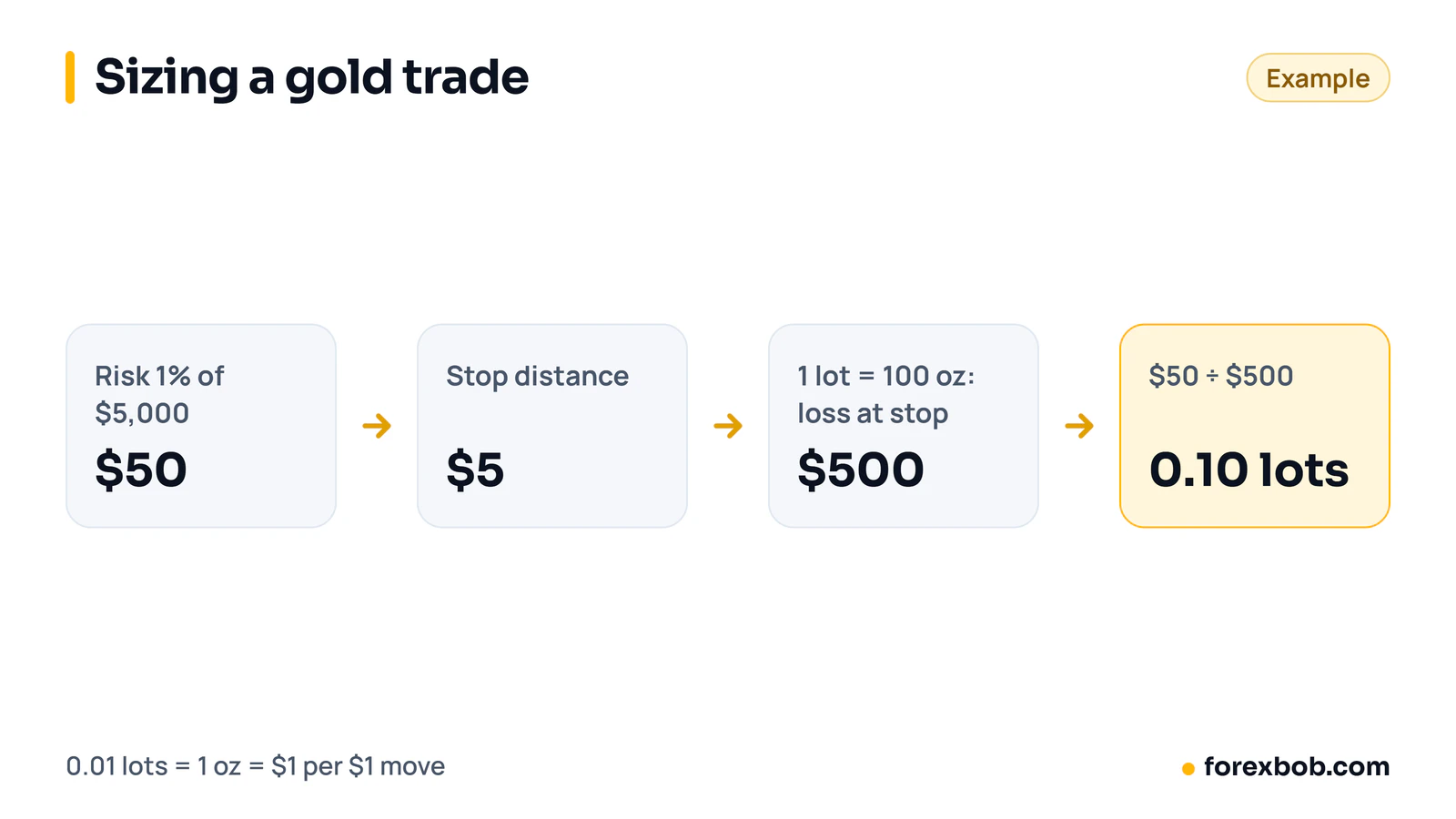
Gold moves in dollars and cents, not in the same pip units as a currency pair. For XAU/USD, 1 standard lot is 100 ounces, so a $1 move is worth $100 per lot and a $0.10 move is worth $10 per lot.
A full example: you have a $5,000 account and risk 1% per trade, so your maximum loss is $50. Your stop is $5 away from your entry. On 1 lot, a $5 move is worth $5 × 100 ounces = $500. To risk only $50, trade $50 ÷ $500 = 0.10 lots. At 0.10 lots, a $5 move against you loses $50, which matches your plan.
Check it a second way: 0.10 lots is 10 ounces (0.10 × 100), and a $5 move on 10 ounces is $50. You can check values with the pip value calculator and work out the lot size with the calculator at the end of this article.
Small accounts need extra care. Even 0.01 lots is 1 ounce, so it gains or loses $1 for every $1 that gold moves; a $10 move against you loses $10. If the correct size is below your broker's smallest lot, the trade does not fit your risk plan, so wait for a setup with a closer stop or skip it.
Daylight saving: why gold hours shift
Daylight saving is a common source of confusion for gold traders, because Europe and the US change their clocks on different dates. For a few weeks each spring and autumn, the gap between London and New York is an hour shorter than usual, so the overlap moves by an hour on the clock. A session that started at 13:00 GMT may appear to start an hour earlier or later in your local time, even though the market itself has not changed.
Check session times on the day you trade and convert them to your own time zone, and note US release times in your own time zone too.
Gold timing mistakes
- Trading a breakout plan in quiet Asian hours, then judging the plan as failed when breaks keep reversing.
- Entering just before a major US release without a plan for wider spreads and slippage.
- Using currency-pair pip maths for gold, instead of dollars multiplied by ounces.
- Trading the same lot size on gold as on EUR/USD, even though gold moves far more in dollar terms.
- Trading the London open with a stop that is too tight for the early volatility.
- Holding gold through the daily break or overnight without checking the break time and swap charges.
- Chasing a fast overlap move after it has already run, instead of waiting for the next planned setup.
FAQ
What is the best time to trade gold?
For most short-term traders, the London–New York overlap, roughly 08:00 to 11:30 New York time (about 13:00 to 16:30 GMT in winter), offers the most movement and usually the tightest spreads. The London morning is next most active, while Asia is normally quieter. The best session also depends on your strategy and the hours you can watch.
What are XAU/USD trading hours?
Spot gold trades almost around the clock on weekdays through brokers, with a short daily break at many brokers at 17:00 New York time. Exact hours vary by broker, so check your broker's gold trading hours and break time. Gaps can occur at the Sunday open.
Is gold more volatile in London or New York?
Both sessions can be volatile, but the overlap of the two is usually the most active period. London builds activity through the European morning, while New York adds US data and dollar moves. Asia is normally quieter, although Asian news can still produce a strong session on some days.
Should beginners trade gold during US news releases?
Beginners are usually better off watching a few releases from the sidelines before trading through them. US inflation, jobs and Federal Reserve releases can move gold by several dollars in minutes, while spreads and slippage often increase. If you do trade the news, use a smaller size and a plan decided before the release.
How do I size a gold trade for 1% risk?
Work out your dollar risk first, then divide it by the dollar loss per lot at your stop distance. On a $5,000 account, 1% is $50. With a $5 stop, 1 lot would lose $500, so $50 ÷ $500 = 0.10 lots. Recalculate for every trade, because a different stop distance changes the correct size.
Our forex calculators page has the tools for sizing gold trades.
Keep reading: trading gold (XAU/USD), the four forex trading sessions and trading around news releases.
Risk note: trading forex carries a high level of risk and may not be suitable for everyone. This article is for education only and is not financial advice.
Position size
0.40 lots
40,000 units
Amount at risk
$100.00
Pip value (1 lot)
$10.00
Mini lots
4.0
Micro lots
40
Have a strategy you want automated?
We turn trading rules into tested Expert Advisors for MT4 and MT5. Tell us how you trade and we'll send a specification and a quote.
More articles
Automated trading8 min read
What is an Expert Advisor (EA) and how does it work?
An Expert Advisor is a program that trades for you in MetaTrader from rules you set. How it works, what it can and can't do, and how to judge one.
Read article
Automated trading8 min read
How to turn your trading strategy into an EA
Turn a trading idea into exact EA rules, test it properly and hire a developer with confidence: the specification, the testing and the red flags.
Read article
Automated trading8 min read
Forex VPS for EAs: do you need one, and how to set it up
A forex VPS keeps your Expert Advisor running when your own computer is off. When you need one, how much power it needs and how to set it up.
Read article