
Analysis8 min read
Best backtesting and replay tools for forex traders (FX Replay, TradingView, MT5)
Manual replay and automated testing answer different questions. How FX Replay, TradingView and MT5 compare, so you can test an idea without fooling yourself.
Forex backtesting software lets you test a trading idea against past price data before you risk money on it, either by replaying charts bar by bar by hand or by running an automated strategy through a tester. The right tool depends on your question: manual replay is best for learning how you react to price action, while automated testing is best for checking fixed rules over a long period. Neither can prove a strategy will work in future, because past results only record what happened under past conditions.
What forex backtesting software can and cannot tell you
A backtest can tell you whether a set of rules would have produced a given pattern of trades on the data you fed it, including how often it traded and how long its losing runs were. That turns a vague idea such as buying pullbacks in an uptrend into a testable claim with entry, stop and exit rules, and it exposes ideas that only look good because you remember the winners.
A backtest cannot tell you how you will behave with real money at stake, how a broker will fill orders during fast news, or how a strategy will cope with a market it has never seen. Treat a backtest as a filter that removes weak ideas, not as a prediction. For a structured starting point, read how to backtest a trading idea before you open any tool, and test across a trend, a range, a volatile period and a quiet period.
Manual replay versus automated testing
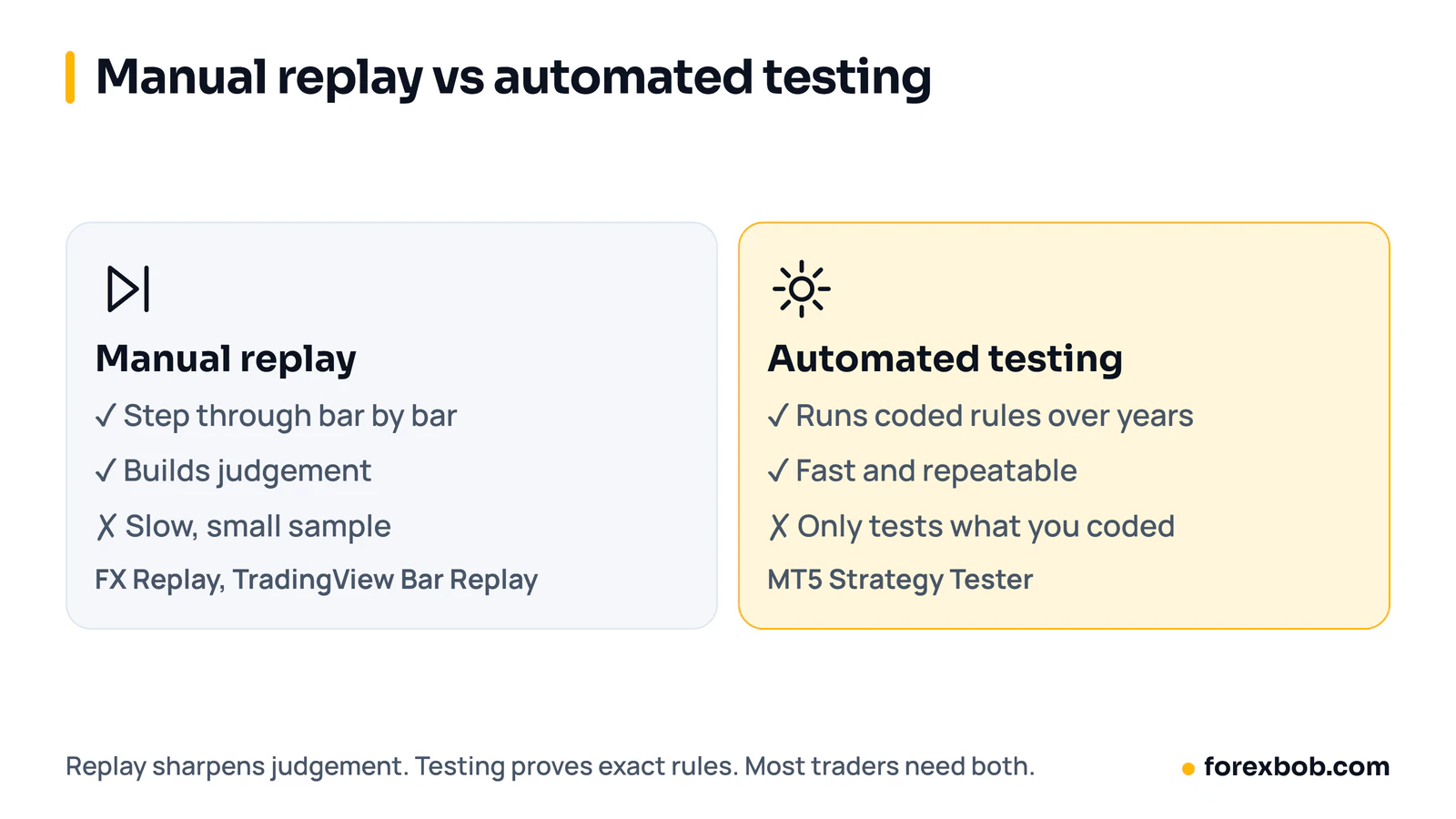
Manual replay means hiding the right side of the chart and moving forward one bar at a time, deciding each time whether you would enter, exit or do nothing, and writing the result down. It is slow, and that is the point: you practise reading price action, placing stops and sitting through losing trades without knowing what happens next.
Automated testing means coding fixed rules and letting software run them over historical data in minutes. It is fast and repeatable, and it removes the temptation to change a rule mid-test. Its weakness is that it only tests what you coded, exactly as you coded it, so a small coding error can produce a confident and completely wrong result.
Many traders use both: manual replay first, then automated testing over a larger sample. If the two disagree sharply, find out why before trusting either.
FX Replay, TradingView and MT5 compared
FX Replay
FX Replay is a browser-based replay tool built for manual backtesting. You load a chart, hide future prices and step forward bar by bar or at a chosen speed, placing practice trades as you go. Its strength is deliberate practice: repeating a setup many times to build pattern recognition, rather than automating a strategy. Check the current price on their site before subscribing, because plans and included data change.
TradingView Bar Replay
TradingView's Bar Replay lets you replay a chart from a chosen point and move forward bar by bar or in playback mode, placing practice trades as the chart unfolds. Its strength is convenience: if you already chart in TradingView, you can practise with the same indicators and layouts you use live. What is available, and how much history, can depend on your plan, so check the current details on their site. Bar Replay is a manual tool, not an automated tester. For other charting platforms, see our guide to TradingView alternatives.
MT5 Strategy Tester
The MT5 Strategy Tester is the built-in tool for testing Expert Advisors and indicators in MetaTrader 5, and it is the natural choice once an idea has become fixed rules. You choose a symbol, a timeframe and a date range, run the EA, and review the trades and the report. Its strength is scale and repeatability: the same EA and settings on the same data should give the same result. Our comparison of MT4 vs MT5 explains why the MT5 tester is the stronger of the two.
The tester also supports optimisation, which runs many setting combinations to find which performed best on the test data. That is useful and dangerous, because the best combination on past data is often the one most fitted to that data, a problem covered later in this article.
Data quality: ticks, bars and spreads
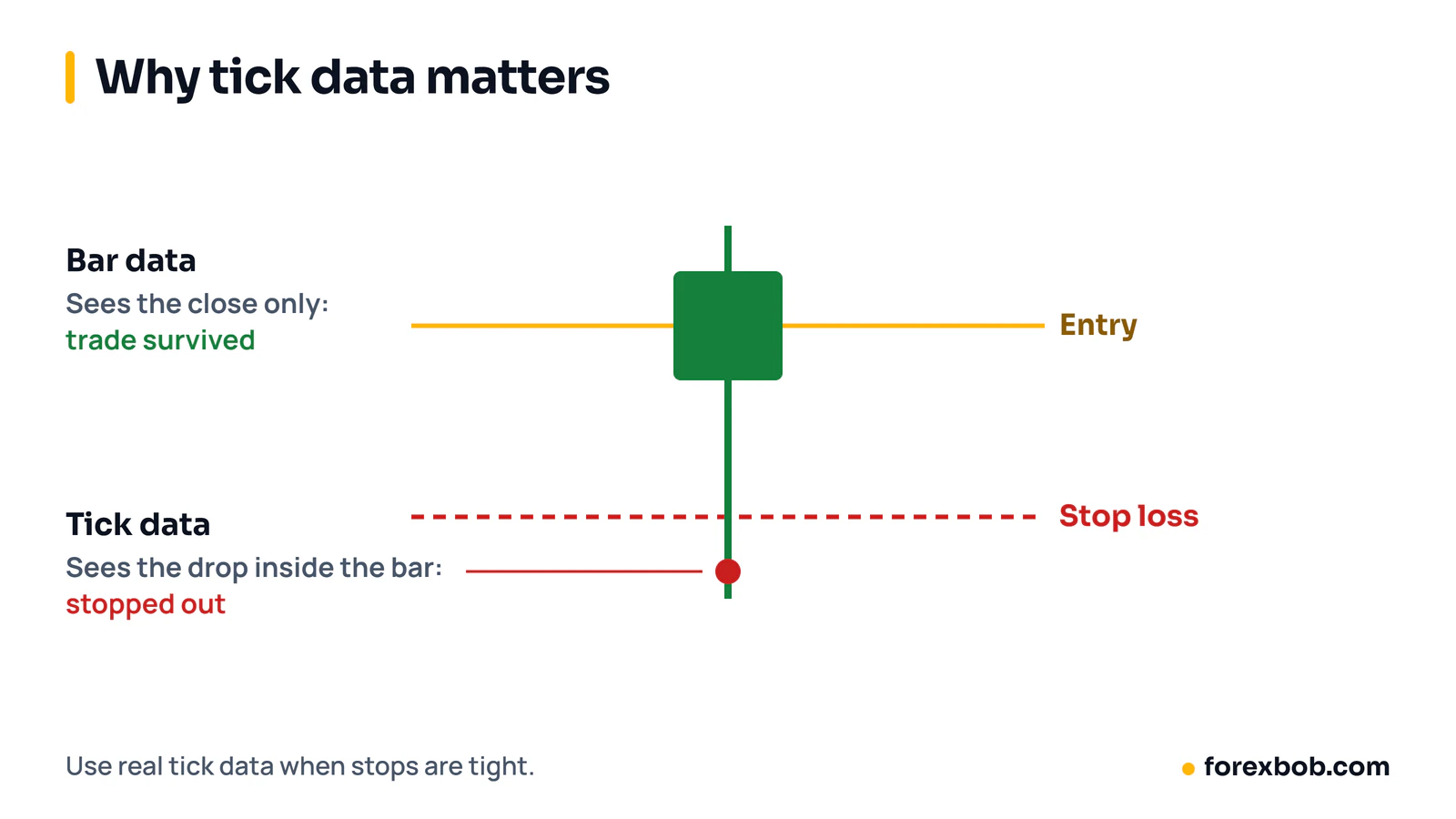
Data quality decides whether a backtest result is worth reading. Bar data gives the open, high, low and close of each period, but hides what happened inside the bar. Tick data records individual price changes, which matters for tight stops: a stop could have been hit inside a bar even if the bar closed in your favour, so bar data alone can show a trade surviving when it would have stopped out.
Spreads matter just as much. Many testers let you set a fixed spread, but real spreads widen during news, at session opens and in thin overnight conditions. A strategy that works with a 1-pip spread may struggle with a 3-pip spread, because every trade pays that cost. Test with a spread that matches, or is wider than, what you normally see, and run a second test with a wider one. If a small spread change turns a positive result negative, the idea depends on costs staying unusually low. For gold (XAU/USD), check the symbol specification too, because it is quoted differently from EUR/USD.
Setting realistic leverage and position size in tests
A backtest is only useful if its account settings match the account you will actually trade. The settings traders most often get wrong are leverage and position size. Read leverage and margin explained if that relationship is not yet clear, because it shapes every number in a tester report.
Here is a worked example. Suppose you have a $1,000 account and you risk 1% per trade: $1,000 × 0.01 = $10. You trade EUR/USD with a 20-pip stop. One standard lot of EUR/USD is worth about $10 per pip, so a 0.05-lot position is worth $10 × 0.05 = $0.50 per pip, and a 20-pip loss costs 20 × $0.50 = $10, matching your plan. If you test with 1.00 lot instead, the same 20-pip loss costs 20 × $10 = $200, or 20% of the account. Use the same position size rule in every test, and work it out with the position size calculator.
Avoiding look-ahead and curve fitting
Look-ahead bias happens when a test uses information that would not have been available at the time of the trade. In manual replay, it happens when you peek at the right side of the chart, or when an indicator repaints, changing past values as new bars arrive. In automated testing, it happens when a rule uses a candle's close before that candle has closed. At each decision point, ask what you would actually have known at that moment, and test only with that.
Curve fitting, also called over-optimisation, happens when you tune settings until they fit one historical period perfectly. A moving average length or a stop distance can be adjusted until the past result looks excellent, but the tuned settings often fail on new data because they captured noise rather than a lasting pattern. The defence is to test on data you did not use for tuning: tune on one period, then check the same settings on a later, untouched period.
Freeze your rules before the test, keep adjustable settings few, and record the tool, data period, spread and position size rule. Our guide on how to keep a trading journal applies to backtests as well as live trades.
Common mistakes
- Peeking at future bars during manual replay, then believing a result that used information you would not have had live.
- Testing on a short, quiet period and treating a handful of trades as proof that a strategy works.
- Using a fixed, unrealistically tight spread, then being surprised when live costs change the outcome.
- Copying position size settings from another pair or account, so the test risks far more, or far less, than planned.
- Optimising settings until the past result looks perfect, then trading them without an untouched check period.
- Using an indicator that repaints without realising it, so signals that look clear in hindsight never appeared that way live.
- Changing the rules halfway through a test because a losing run feels uncomfortable.
- Judging a strategy only by its best period, while ignoring its losing runs and its behaviour in ranges and trends.
FAQ
What is the best forex backtesting software for beginners?
There is no single best tool, because beginners need different things at different stages. Manual replay tools such as FX Replay or TradingView's Bar Replay are a good starting point for learning price action, while the MT5 Strategy Tester is better once your idea has become fixed rules. Start with manual replay if you trade by discretion.
Is manual backtesting better than automated backtesting?
Neither is better in general, because they answer different questions. Manual backtesting teaches judgement, patience and position sizing under uncertainty, while automated backtesting checks a fixed rule set over a large sample without emotion. Most traders benefit from both: manual practice first, then automated testing.
How much historical data do I need for a reliable backtest?
You need enough trades, across different market conditions, for the pattern to mean something, rather than a fixed number of years. Aim for dozens of trades at the very least, covering a trend, a range and a volatile period.
Why do backtest results differ from live trading results?
Live trading adds spread widening, slippage, data differences and your own reactions under real risk, none of which a clean historical test fully captures. A backtest also uses the settings and data you chose, which may not match your live account. A large gap usually points to costs, position size or a rule that was not tested the way it is traded.
Can I backtest a strategy without coding?
Yes. Manual replay tools let you backtest without coding, by stepping through charts bar by bar and recording practice trades. Coding becomes necessary only when you want automated testing over a large sample, or an Expert Advisor.
Manual replay builds judgement, automated testing checks rules at scale, and honest data settings keep both honest. Pick the tool that matches your question, freeze your rules before you test and keep a record you can re-check. If your tested rules are ready to become an automated strategy, see our EA development page.
Keep reading: how to backtest a trading idea, MT4 vs MT5 and TradingView alternatives.
Risk note: trading forex carries a high level of risk and may not be suitable for everyone. This article is for education only and is not financial advice.
Have a strategy you want automated?
We turn trading rules into tested Expert Advisors for MT4 and MT5. Tell us how you trade and we'll send a specification and a quote.
More articles
Automated trading8 min read
What is an Expert Advisor (EA) and how does it work?
An Expert Advisor is a program that trades for you in MetaTrader from rules you set. How it works, what it can and can't do, and how to judge one.
Read article
Automated trading8 min read
How to turn your trading strategy into an EA
Turn a trading idea into exact EA rules, test it properly and hire a developer with confidence: the specification, the testing and the red flags.
Read article
Automated trading8 min read
Forex VPS for EAs: do you need one, and how to set it up
A forex VPS keeps your Expert Advisor running when your own computer is off. When you need one, how much power it needs and how to set it up.
Read article