
Forex prop firms explained: funded accounts, the rules and using EAs
What prop trading is, how forex funded account challenges work, the drawdown rules that end most attempts, what firms allow with EAs, and the maths behind passing.

Prop trading is short for proprietary trading: trading with a firm's money instead of your own. At banks and trading houses it means staff traders using the firm's capital. The forex prop firms advertised online work differently. You pay a fee to take a trading challenge, and if you pass, you get a funded account and a share of the profits.
Here is how those challenges work, the rules that end most attempts, what firms allow with EAs, and some honest maths about the odds.
How a forex funded account challenge works
Details vary from firm to firm, but a typical two-step challenge looks like this:
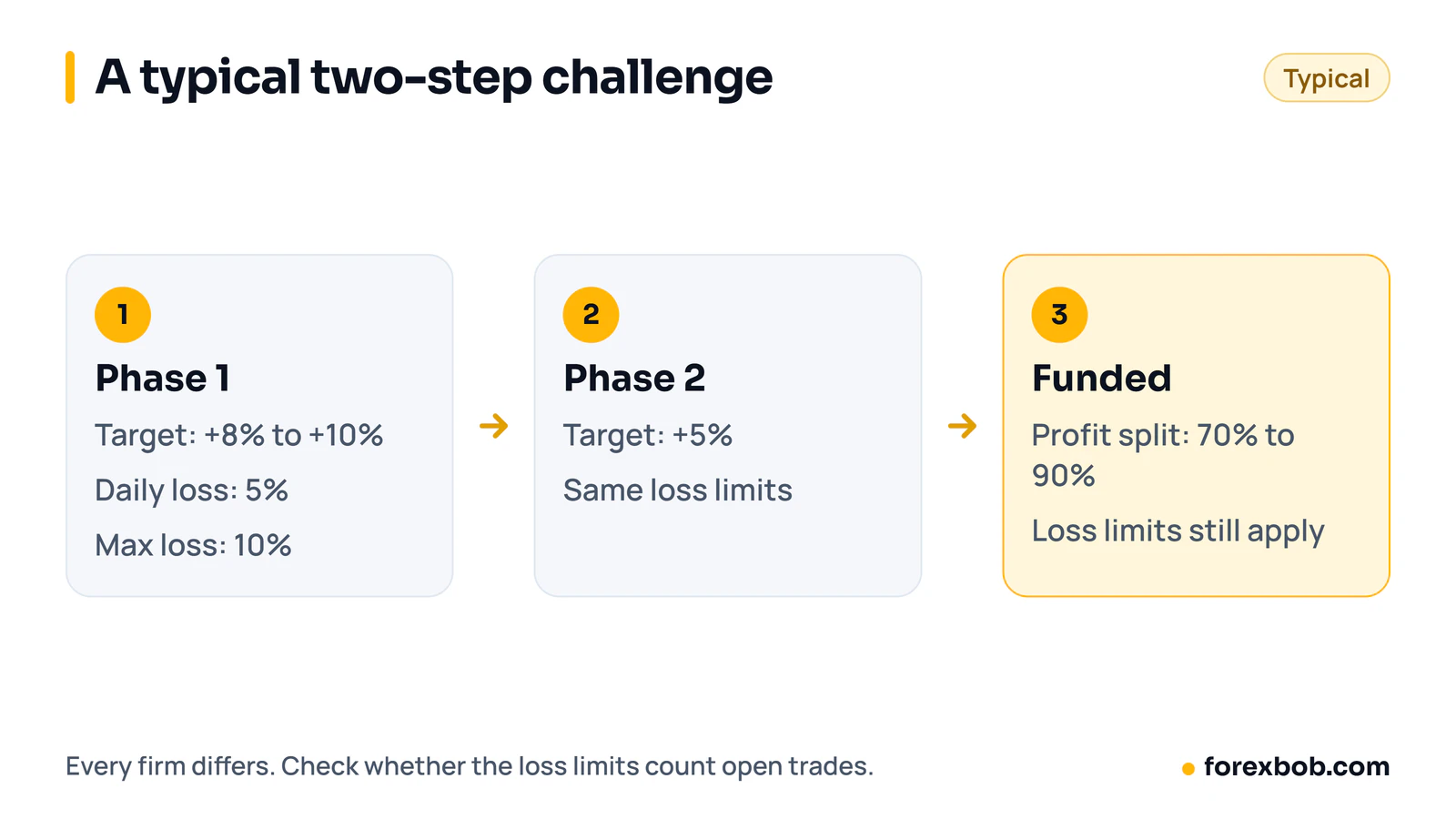
- Phase 1: reach a profit target, often 8% to 10%, without breaking the loss limits.
- Phase 2: reach a smaller target, often 5%, under the same limits.
- Funded: trade the firm's account and keep a share of profits, commonly 70% to 90%. The challenge fee is sometimes refunded with the first payout.
Many firms also offer one-step challenges and instant funding with tighter rules. Read the exact terms, because two firms with the same headline numbers can measure them differently.
Where the money comes from
Many retail prop firms run funded accounts on simulated capital and pay traders from their own funds, which include challenge fees. That is not automatically a problem, but it means the firm's income depends heavily on fees, and it explains why rules can change. Check how long a firm has been paying out, what its terms say about refusing payouts, and which platform your account will run on. In 2024 several firms had to move platforms at short notice after losing access to MetaTrader.
The rules that end most attempts
Daily loss limit
Usually around 5% of the starting balance. The key detail is how it is measured. Some firms count only closed trades. Many count equity, including open losses, from the day's starting balance or equity. Under an equity rule, a trade that dips 5% against you before recovering still fails the challenge.
Maximum loss
Usually around 10%. A static maximum loss stays fixed at, say, $90,000 on a $100,000 account. A trailing maximum loss rises with your highest balance or equity, so after a good run your room to lose is still only 10% below the peak. Trailing rules are much harder to live with.
Other common rules
- A minimum number of trading days
- Limits on trading around high-impact news
- Rules on holding over weekends
- A consistency rule, where no single day can make too much of the total profit
Can you use an EA?
Many firms allow Expert Advisors, but almost all ban some kinds. Commonly banned:
- High-frequency, tick scalping and latency arbitrage EAs
- Copying the same trades across accounts, or hedging between accounts
- Using the same off-the-shelf EA as many other customers, which firms can spot as identical trades
- At some firms, grid and martingale systems
Even where grid and martingale EAs are allowed, the rules work against them. A grid builds open losses before it recovers, and an equity-based daily limit counts those losses. We rebuilt a grid EA that made 77% on AUD/CAD in calm months and then lost more than 90% in a single crash. Under a 10% maximum loss, that kind of system is finished on its first bad move. Our article on grid and martingale risks explains why.
The maths of passing
Imagine a trader with no edge at all: every trade has zero expected value, and trades are small compared with the limits. The chance of reaching a profit target before a loss limit is roughly the loss room divided by the total distance between the two.
- Phase 1, +8% target, 10% maximum loss: 10 ÷ 18, about 56%.
- Phase 2, +5% target, 10% maximum loss: 10 ÷ 15, about 67%.
- Both phases: about 37%.
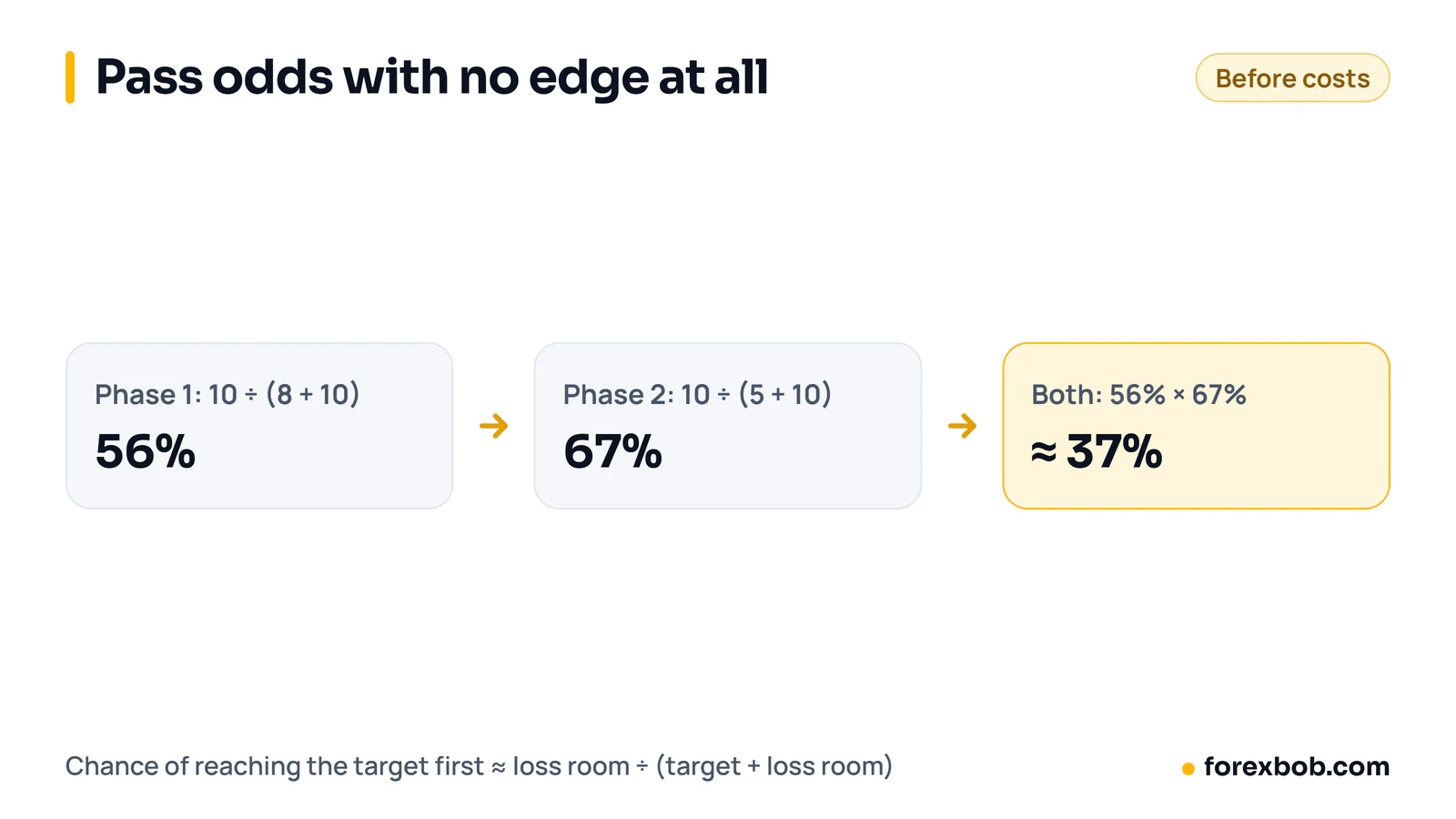
So a trader with no skill passes about a third of the time, before costs. Spread, commission and the daily limit pull that down further. It shows why a pass on its own proves little, and why the real test is staying funded afterwards. A trader with a real edge does better, but the pass rate is not proof of one.
How to size trades for a challenge
The limits decide your risk per trade. With a 5% daily loss limit, risking 1% per trade means five losses in one day ends the attempt. Risking 0.5% gives you ten. With a 10% maximum loss, a run of ten 1% losses ends it, and runs that long are more common than most people expect. Our article on losing streaks has the numbers.
- Risk 0.5% to 1% per trade, not more.
- Set your own daily stop well inside the firm's, for example 2% to 3%.
- Count open losses as real if the firm does.
- Avoid trading into news if the firm restricts it, even with an EA. Turn the EA off around big releases if it has no news filter.
The position size calculator below turns any risk percentage into a lot size for your stop.
Keep reading: how much to risk per trade, forex risk management, grid and martingale EA risks and drawdowns and losing streaks.
Risk note: trading forex carries a high level of risk and may not be suitable for everyone. This article is for education only and is not financial advice.
Position size
0.40 lots
40,000 units
Amount at risk
$100.00
Pip value (1 lot)
$10.00
Mini lots
4.0
Micro lots
40
Have a strategy you want automated?
We turn trading rules into tested Expert Advisors for MT4 and MT5. Tell us how you trade and we'll send a specification and a quote.
More articles

Supply and demand trading: how to mark zones, and what testing shows
How to find supply and demand zones, draw them, enter and place stops. Then what happened when we tested a zone strategy on seven years of EUR/USD.
Read article
Forex risk management: the complete guide
Everything that decides how much you can lose, in one place: risk per trade, sizing, stops, leverage, correlated trades, drawdown limits and the extra risks of EAs.
Read article
ICT trading strategy explained, and what testing shows
Liquidity sweeps, market structure shifts, fair value gaps, kill zones and the silver bullet in plain terms, and what happened when we measured some of them on gold.
Read article