
Forex risk management: the complete guide
Everything that decides how much you can lose, in one place: risk per trade, sizing, stops, leverage, correlated trades, drawdown limits and the extra risks of EAs.

Risk management decides how much you lose when you are wrong, and you will be wrong often. Good entries help, but traders rarely blow up from bad entries. They blow up from one oversized trade, a losing streak they didn't plan for, or several trades that turned out to be the same bet.
This guide pulls the whole subject together. Each section links to a fuller article.
1. Risk a small, fixed share per trade
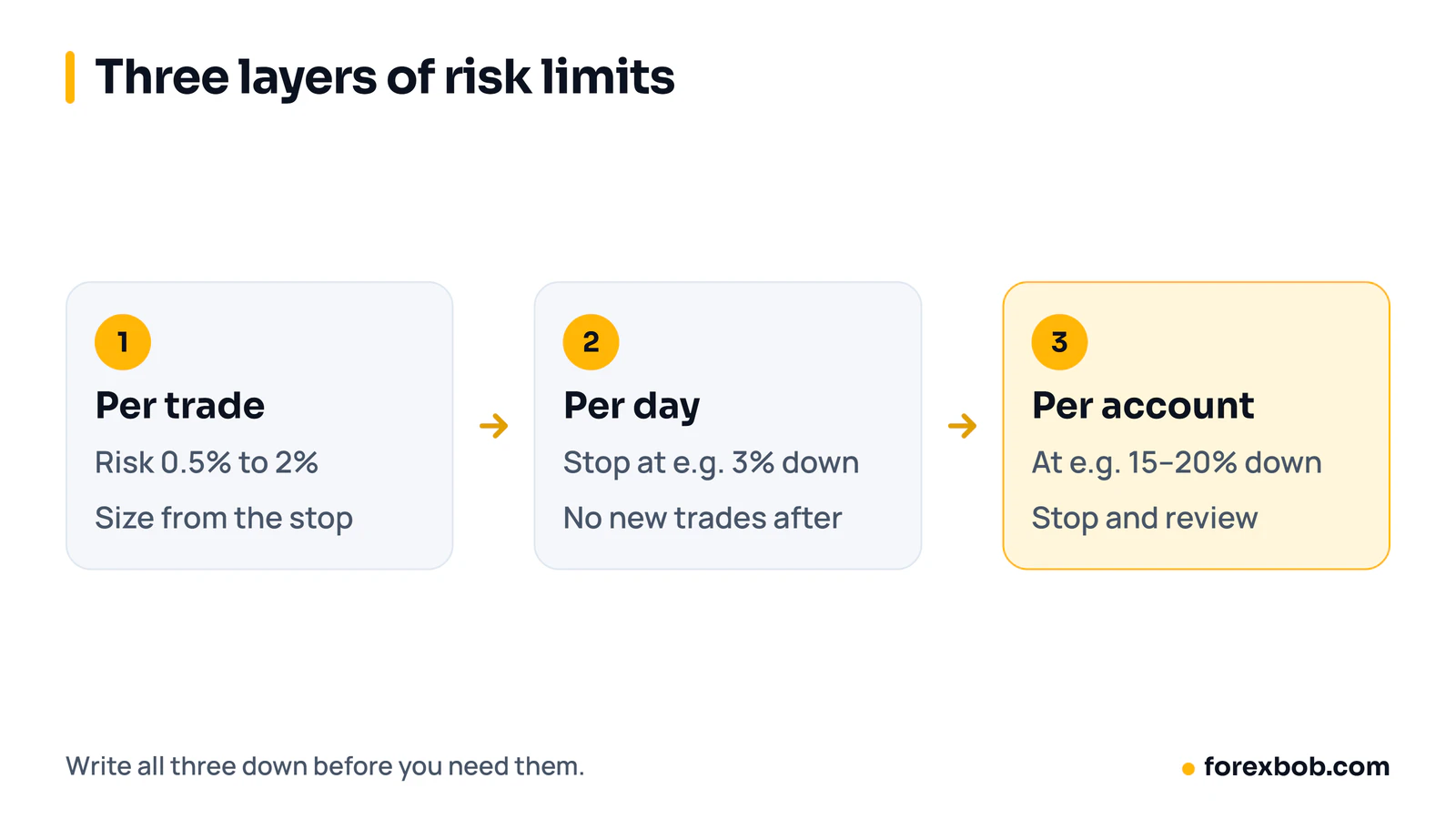
Most professionals risk between 0.5% and 2% of their account on one trade. At 1%, a run of ten losses costs about 10%. At 10% per trade, the same run costs about 65%, and you would need to nearly triple what is left just to get back to the start. Start low. You can raise it once you have a record you trust. Full detail: how much to risk per trade.
2. Size every position from the stop
Risk is a sum of money, not a lot size. Lots = money at risk ÷ (stop in pips × pip value per lot). A wide stop means a small position, and a tight stop a bigger one, with the same money at risk either way. The calculator at the bottom of this page does it for you, and lot sizes explained covers the units.
3. Put the stop where the idea is wrong
Pick the level that proves the trade wrong first, then size around it. Never work backwards from the lot size you want. Read where to place a stop loss, and stop loss vs stop limit for how the order itself behaves in a gap.
4. Know your break-even win rate
Win rate means nothing without the size of wins and losses. At 1:2 risk-reward you need just over 33% wins to break even before costs. At 1:0.5 you need 67%. Track your average win and loss in R. See risk-reward ratio vs win rate.
5. Treat leverage as a limit
High leverage doesn't change how much you risk if you size from the stop. It changes how much room you have before a margin call, and how tempting it is to oversize. Read leverage and margin explained.
6. Count correlated trades as one
Two 1% trades on pairs that move together behave like one 2% trade. This is easy to underestimate in forex, because every pair shares a currency with many others.
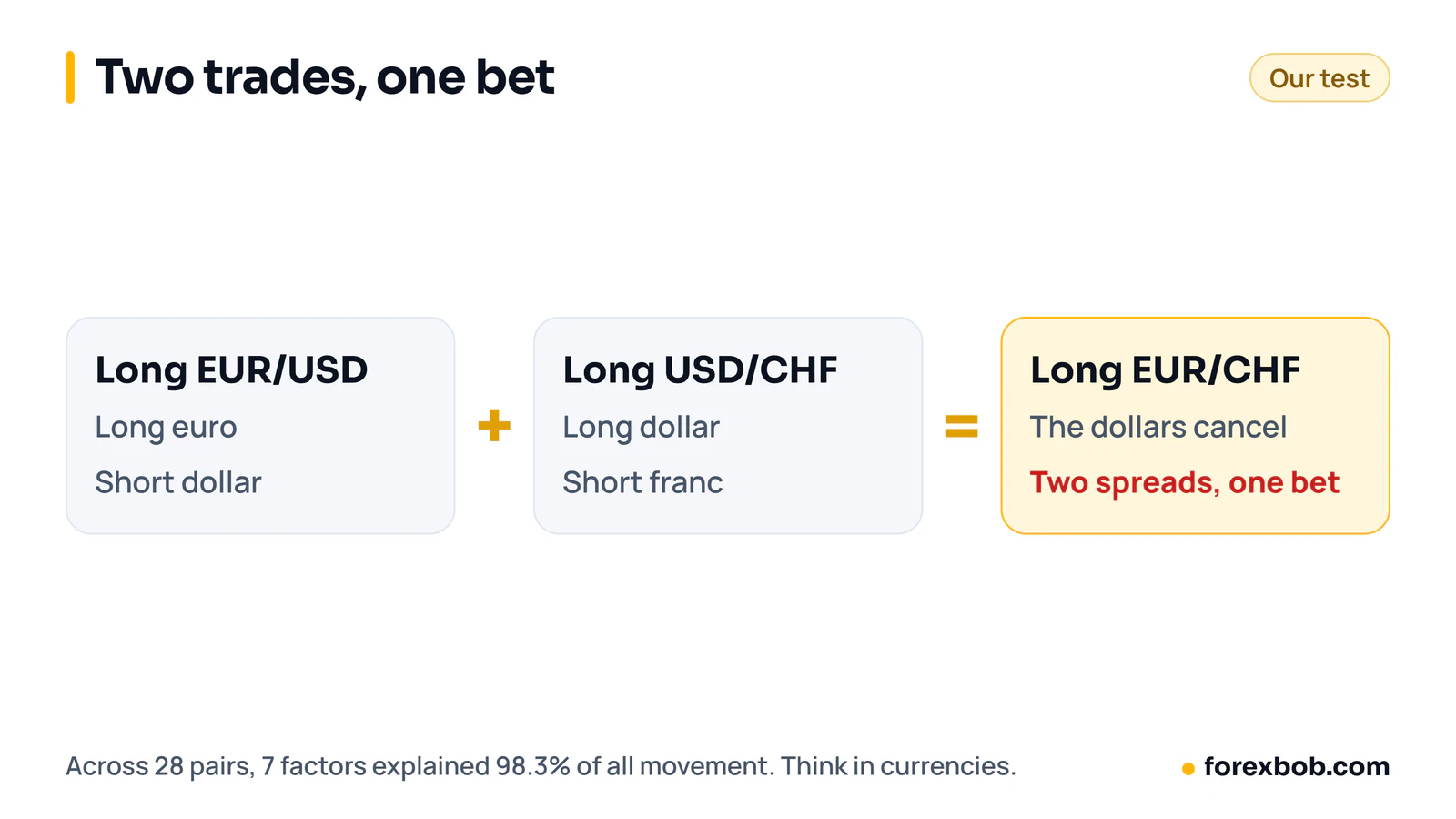
We measured it. Across 28 major and cross pairs, seven underlying factors explained 98.3% of all the movement. The strongest negative correlations, like EUR/USD against USD/CHF at −0.77, are the same currency on opposite sides: long both is just EUR/CHF, traded twice and paying two spreads. Think in currencies. If three trades are all short the US dollar, that is one bet.
7. Expect losing streaks
With a 40% win rate, the chance of eight losses in a row somewhere in 100 trades is about one in two. Plan for it in advance so it doesn't push you into bigger trades. See drawdowns and losing streaks and how many losing trades in a row is normal.
8. Set daily and total loss limits
A daily limit (for example 3%) stops one bad day becoming a bad month. A total drawdown limit (for example 15% to 20%) tells you when to stop and review. Write both down before you need them. When you hit one, use the plan in how to recover from a drawdown.
9. Understand risk of ruin
Risk of ruin is the chance a run of losses takes your account below the point where you can carry on. It grows very fast with risk per trade. Our risk of ruin guide shows the curves.
10. Plan for gaps and news
Stops don't protect you from gaps. A weekend or news gap can fill your stop far beyond where you set it. Trade smaller before big releases and weekends, and know the times. See trading forex news releases.
11. Know what your EA risks
An Expert Advisor's risk is in its rules, and some rules hide it. Grid and martingale EAs keep adding to losing positions, so the first trade size tells you nothing. We rebuilt one on AUD/CAD that made 77% in calm months, then lost over 90% in one crash. On another grid EA, adding a hard equity stop at 20% removed every wipe-out in the test at the cost of some profit. Read grid and martingale EA risks and how to judge an Expert Advisor.
12. Follow the rules of the account
Prop firm accounts add their own limits, often a 5% daily and 10% maximum loss, sometimes counting open losses. Size for those limits, not for your ambition. See forex prop firms explained.
13. Keep a journal
You can't manage what you don't record. Log every trade's risk, result in R and whether you followed your rules. Our trading journal guide includes a free template.
A one-page checklist
- Risk per trade: fixed, 0.5% to 2%
- Stop set from the chart, size from the stop
- Break-even win rate known for the setup
- Total exposure per currency checked
- Daily loss limit and total drawdown limit written down
- News and weekend plan
- EA rules understood, including what happens in a trend against it
Keep reading: how much to risk per trade, where to place a stop loss, risk of ruin in trading and the position size calculator.
Risk note: trading forex carries a high level of risk and may not be suitable for everyone. This article is for education only and is not financial advice.
Position size
0.40 lots
40,000 units
Amount at risk
$100.00
Pip value (1 lot)
$10.00
Mini lots
4.0
Micro lots
40
Have a strategy you want automated?
We turn trading rules into tested Expert Advisors for MT4 and MT5. Tell us how you trade and we'll send a specification and a quote.
More articles

Supply and demand trading: how to mark zones, and what testing shows
How to find supply and demand zones, draw them, enter and place stops. Then what happened when we tested a zone strategy on seven years of EUR/USD.
Read article
Forex prop firms explained: funded accounts, the rules and using EAs
What prop trading is, how forex funded account challenges work, the drawdown rules that end most attempts, what firms allow with EAs, and the maths behind passing.
Read article
ICT trading strategy explained, and what testing shows
Liquidity sweeps, market structure shifts, fair value gaps, kill zones and the silver bullet in plain terms, and what happened when we measured some of them on gold.
Read article