
ICT trading strategy explained, and what testing shows
Liquidity sweeps, market structure shifts, fair value gaps, kill zones and the silver bullet in plain terms, and what happened when we measured some of them on gold.

ICT stands for Inner Circle Trader, the name used by Michael J. Huddleston, who has taught his approach in free videos and paid mentorships for many years. His ideas are often called smart money concepts. The core claim is that price moves to collect liquidity, meaning clusters of stop orders, before making its real move.
There isn't one single ICT strategy. There is a set of concepts that get combined into setups. Below are the main ones, then how they fit into a trade, then what we found when we measured some of them.
Liquidity
Liquidity in ICT terms means places where stop orders are likely to be resting. Buy-side liquidity sits above swing highs and equal highs, where sellers' stops are. Sell-side liquidity sits below swing lows and equal lows, where buyers' stops are.
A liquidity sweep (or stop hunt) is when price pokes through one of those levels, triggers the stops, and then reverses. ICT traders wait for the sweep before looking for an entry the other way.
Market structure shift
In an uptrend price makes higher highs and higher lows. A break of structure (BOS) is price taking out the last high in the direction of the trend. A market structure shift (MSS), also called a change of character, is the first break the other way. For example, in a downtrend, price breaking above the last lower high.
Fair value gaps
A fair value gap (FVG) is a three-candle pattern. In a fast move up, if the first candle's high is below the third candle's low, the space between them is the gap. Price moved through it so quickly that there was little trading there. ICT traders expect price to come back and fill some of it, and often enter there.
Order blocks
An order block is the last opposite candle before a strong move that breaks structure. In ICT setups it often sits near a fair value gap, and the two together mark the entry area.
Premium, discount and OTE
Take the range from a swing low to a swing high. Above 50% is premium, below 50% is discount. ICT traders buy in discount and sell in premium. The optimal trade entry (OTE) is a retracement of roughly 62% to 79% of that range, close to the Fibonacci levels our Fibonacci guide covers.
Kill zones and the silver bullet
ICT puts a lot of weight on time of day. The kill zones are the windows when he expects the big moves, usually given in New York time:
- Asian kill zone: about 8 p.m. to midnight
- London kill zone: about 2 a.m. to 5 a.m.
- New York kill zone: about 7 a.m. to 10 a.m.
- London close: about 10 a.m. to noon
The silver bullet is a one-hour setup, most often taught for 10 to 11 a.m. New York time: wait for a liquidity sweep, then enter on a fair value gap in the other direction. Power of three describes the day as accumulation, manipulation and distribution: a quiet range, a false move that sweeps liquidity, then the real move.
How it fits into one trade
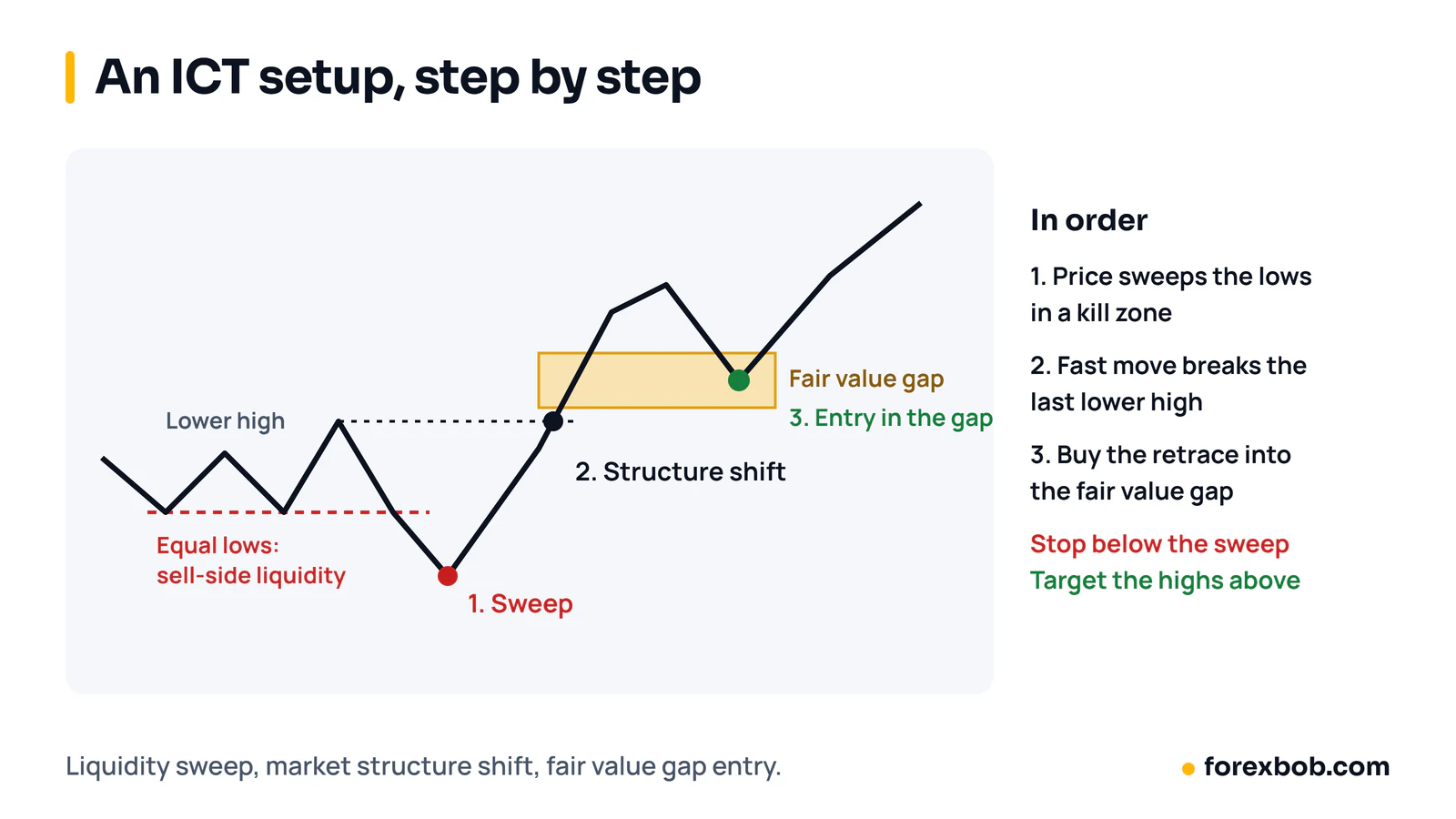
- Pick a direction from the higher timeframe, such as the daily trend.
- In a kill zone, wait for price to sweep liquidity against that direction, for example taking out the Asian session low.
- Look for a market structure shift back the other way, with displacement that leaves a fair value gap.
- Enter when price comes back into the gap or the order block, ideally in discount for a buy.
- Put the stop beyond the sweep's extreme and target the opposite liquidity.
What testing showed
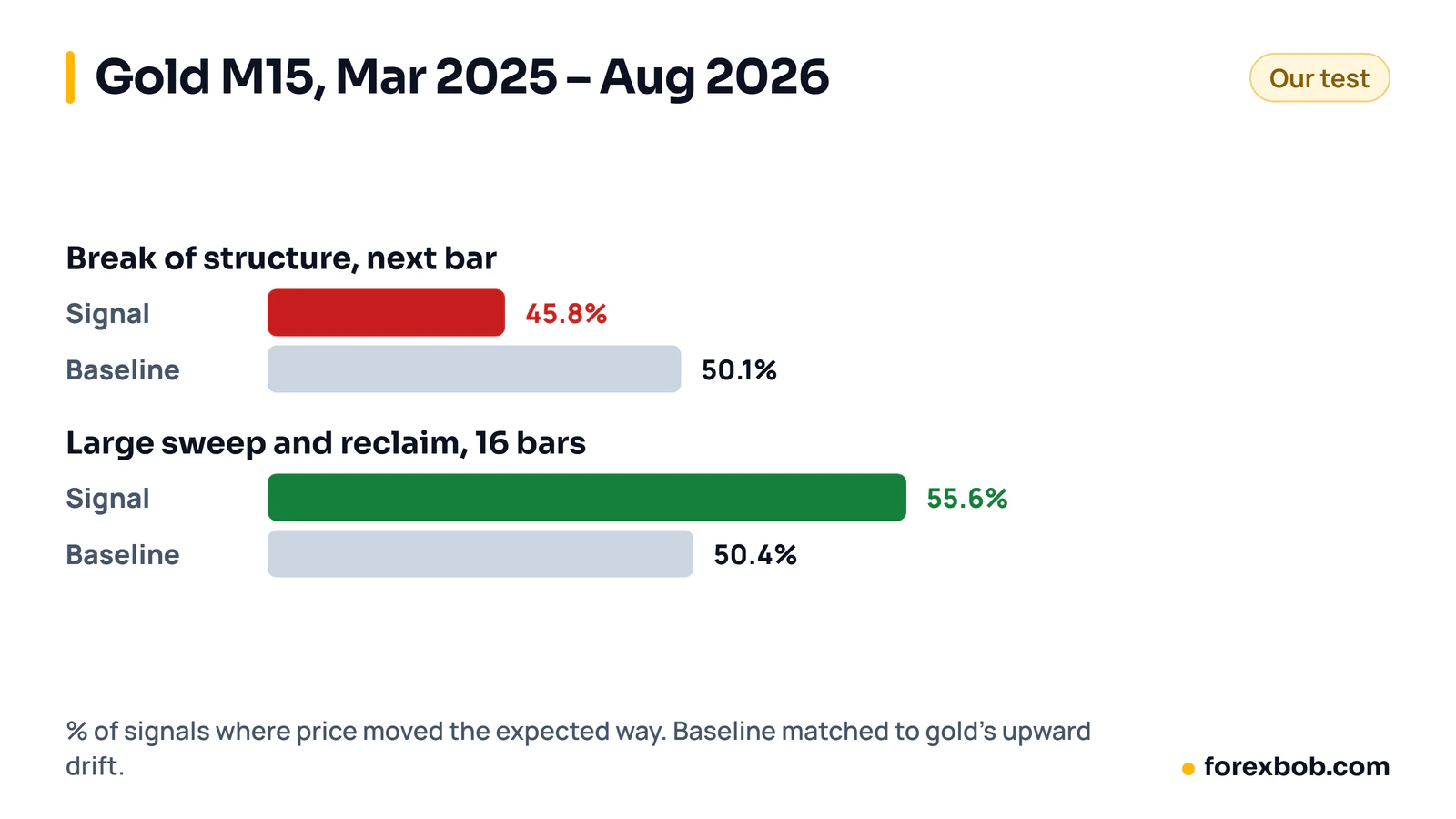
ICT concepts are mostly taught on hand-picked charts, so we measured some of them. A popular TradingView indicator draws structure breaks and sweep-and-reclaim moves automatically. We checked its signals on 32,333 fifteen-minute gold candles, from March 2025 to August 2026, against how often gold went up anyway in that period.
- Breaks of structure were followed by price continuing in the break's direction only 45.8% of the time on the next bar, 4.3 points worse than the baseline. That is the wrong way round for a continuation signal, and the effect faded to nothing after 16 bars.
- Large liquidity sweeps that reclaimed the level did better: 55.6% of the time price moved the expected way over the next 16 bars, about 5 points above the baseline.
- As a trade, with a stop, a 1:1.5 target and costs included, the best sweep version made +0.05R per trade. It won 57.8% of trades in the first half of the data and 52.9% in the second.
We also tested a plain Asian-range breakout on gold, close to the London kill zone idea. On the hourly chart from 2019 to 2026 it lost 0.07R per trade over 732 trades, and six of the eight years were negative.
So the liquidity sweep idea had something small in it. The structure break, which most ICT setups lean on, did not help on its own here. Neither result is a full ICT model with every filter, but it is a fair warning that each piece needs testing on its own, with costs, before you trust the combination.
Before you trade it
- Write the rules down exactly. "Wait for displacement" needs a number, such as a candle at least 1.5 times the average range, or it can't be tested.
- Count every setup, not the best ones. ICT examples are almost always chosen after the fact.
- Convert the times. Kill zones are in New York time. Your broker's server clock is probably two or three hours ahead of London.
- Size for losing streaks. Setups with a 1:3 target lose more often than they win. See drawdowns and losing streaks.
Keep reading: order block trading, supply and demand trading, the four forex trading sessions and the best time to trade gold.
Risk note: trading forex carries a high level of risk and may not be suitable for everyone. This article is for education only and is not financial advice.
Have a strategy you want automated?
We turn trading rules into tested Expert Advisors for MT4 and MT5. Tell us how you trade and we'll send a specification and a quote.
More articles

Supply and demand trading: how to mark zones, and what testing shows
How to find supply and demand zones, draw them, enter and place stops. Then what happened when we tested a zone strategy on seven years of EUR/USD.
Read article
Forex risk management: the complete guide
Everything that decides how much you can lose, in one place: risk per trade, sizing, stops, leverage, correlated trades, drawdown limits and the extra risks of EAs.
Read article
Forex prop firms explained: funded accounts, the rules and using EAs
What prop trading is, how forex funded account challenges work, the drawdown rules that end most attempts, what firms allow with EAs, and the maths behind passing.
Read article