
Trading psychology8 min read
How to recover from a trading drawdown without making it worse
A drawdown feels urgent, but recovery is a slow process. How to pause, cut your size and rebuild with clear rules.
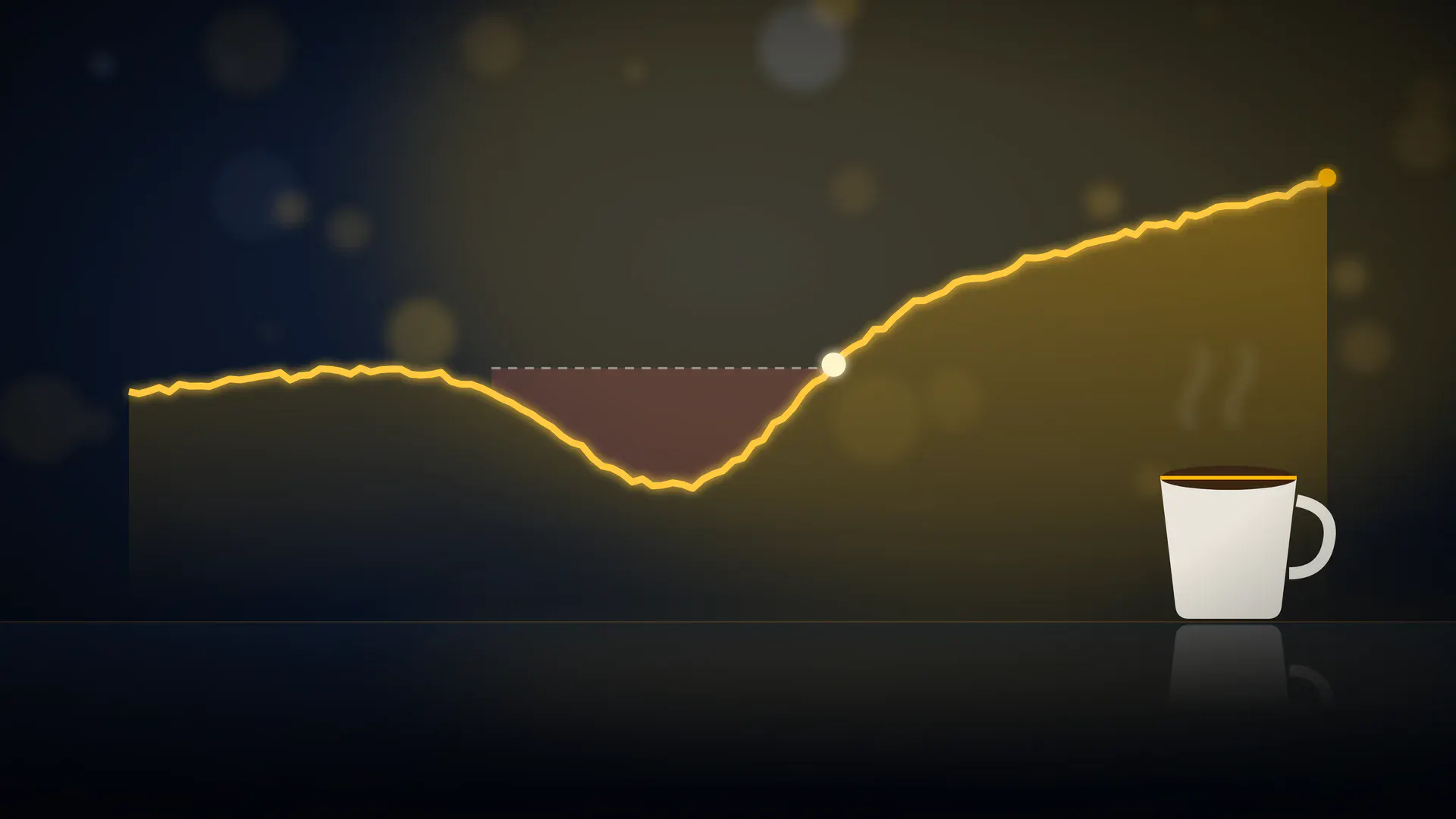
Recovering from a trading drawdown starts with one decision: stop trying to win the money back quickly. A drawdown is a fall from a peak account balance, and recovery means rebuilding that balance through steady, well-sized trades, not through one large trade. The harder you try to force it, the more likely you are to take larger risks, break your rules and deepen the loss.
How to recover from a trading drawdown, step by step
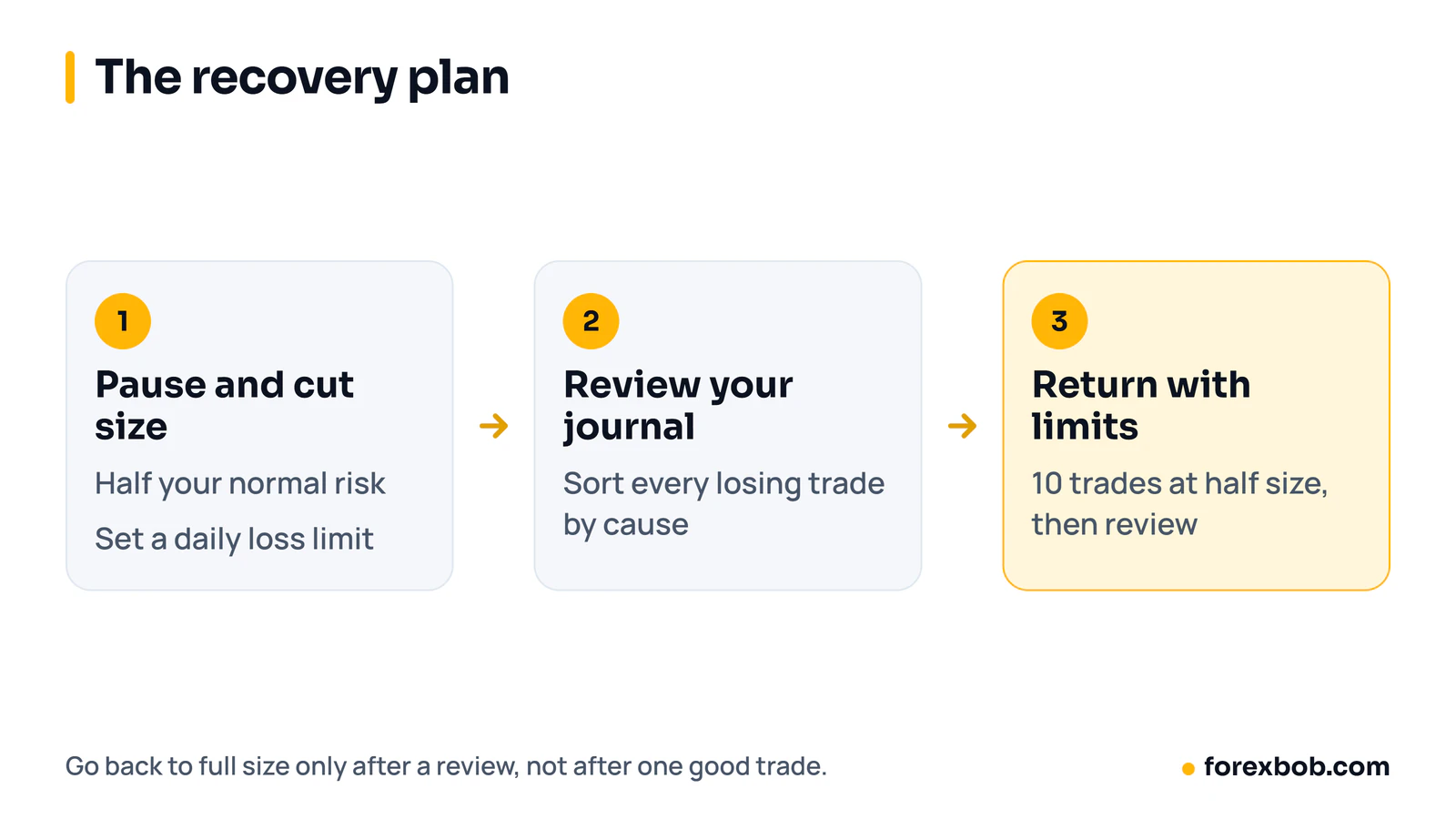
Recovery has a clear order, and the order matters: protecting capital comes first, understanding comes second and trading again comes third. Many traders reverse it. They trade first, hope for a quick win, and only look at their records after another loss.
Think of it in three phases:
- A pause and a cut in position size.
- A review of your journal and your rules.
- A limited return, with a smaller size and a daily loss limit, until your results and discipline are stable again.
If you use an Expert Advisor, the same order applies: pause it or reduce its risk, review its trades against its rules, and only restart it at full size once you understand why it lost.
Why recovery maths makes quick wins unlikely
The maths works against you. A percentage loss needs a larger percentage gain to get back to the starting balance, because the gain is calculated on a smaller balance. On a $10,000 account:
- A 10% loss leaves $9,000. Getting back to $10,000 needs $1,000, and $1,000 ÷ $9,000 = 11.1%.
- A 25% loss leaves $7,500. Getting back needs $2,500, and $2,500 ÷ $7,500 = 33.3%.
- A 50% loss leaves $5,000. Getting back needs $5,000, and $5,000 ÷ $5,000 = 100%.
Those numbers explain why cutting size early matters. A small drawdown is a routine setback, while a large one becomes a long project. Doubling your risk after a 25% loss does not change the maths. It only raises the chance of a 50% drawdown, where recovery needs a 100% gain. For more background, read our guide to drawdowns and losing streaks, and see risk of ruin in trading for what a long streak does at different risk levels.
Step 1: pause and reduce your position size
The first practical step after a large loss is to pause. That can be one day, a few days or longer, depending on how you feel and how large the loss was. The point is to break the link between the last loss and the next trade. If you open the next trade while you are still angry or desperate to recover, it is often driven by emotion rather than by your plan.
When you return, reduce your position size. A common approach is to cut your normal risk in half until you have a run of trades that followed your plan, win or lose. If you normally risk 1% per trade on a $10,000 account, that is $100 per trade; cutting to 0.5% means risking $50. Work out the exact lot size for the smaller risk with the position size calculator.
A smaller size limits further damage while your confidence is fragile, and it makes your rules easier to follow, because each trade matters less. Set a daily loss limit as well: for example, stop for the day after two losing trades, or after losing 2% of your account in one day. Write the limit down before the session starts, because a limit decided in advance is far easier to respect than one invented after the losses have happened.
Step 2: review your journal, and separate bad luck from a broken strategy
Once you have paused, review your trading journal trade by trade. A journal should show the pair, the entry and exit, the stop and target, the reason for the trade and whether you followed your rules. Without that detail, you cannot tell whether you had bad luck, broke your rules or followed a strategy that no longer works. If you do not keep one yet, our guide on how to keep a trading journal explains a simple format.
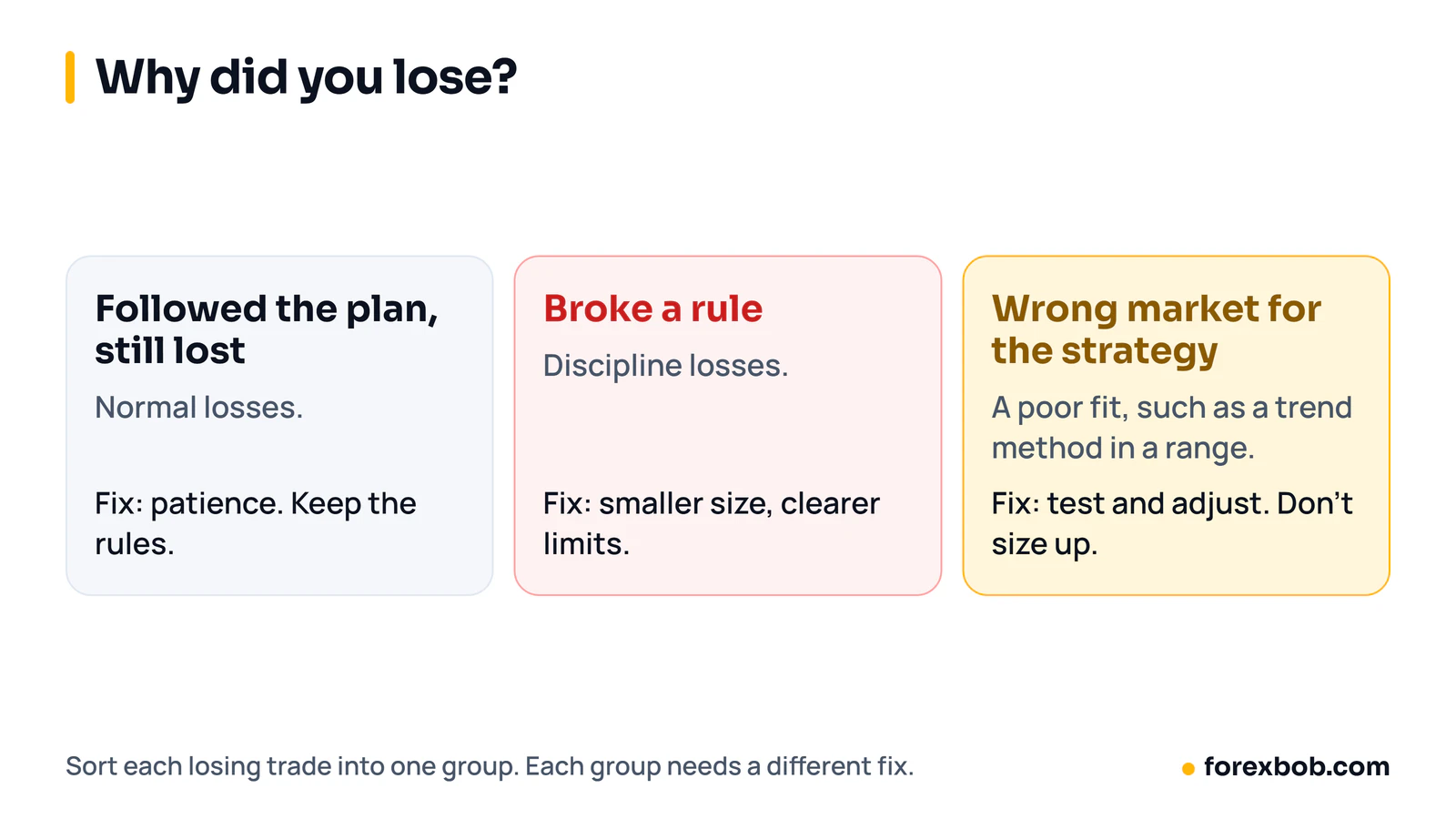
Sort the losing trades into three groups:
- Followed the plan but lost. These are normal losses, and a cluster of them can happen even with a sound approach.
- Broke a rule, such as moving a stop or entering early. These are discipline losses, and they point to behaviour, not to the strategy.
- Market conditions the strategy does not handle, such as a long sideways period for a trend strategy.
Each group needs a different fix. Bad luck needs patience and unchanged rules. Rule-breaking needs a smaller size, clearer limits and often a pause. A strategy that no longer fits the market needs testing and adjustment, not a larger size. Changing strategy after every losing run is also a mistake, because you may throw away a sound approach during a normal streak. For context, see how many losing trades in a row is normal.
We have been tempted by this ourselves. To shorten the losing runs of one of our gold EAs, we tested extra trend, session and loss-cap filters. Each looked better on the data it was built on and worse on later data, so the EA kept its original rules.
Step 3: rules for coming back to live trading
Returning to live trading should feel almost boring. You have a written plan, a reduced size, a daily loss limit and a set number of trades before you review again. For example, you might trade at half size for ten trades, then review those ten before deciding whether to return to full size. The review looks at rule-following first and profit second.
Keep the number of pairs and sessions small during recovery. One or two familiar pairs, such as EUR/USD or GBP/USD, in one planned session, make the review simpler and discipline easier. Decide in advance what will make you pause again, such as two rule breaks in one week or a further drawdown of a set size.
If you trade with an Expert Advisor, restart it on demo or at reduced risk first, and only scale up after a review period. If you are turning a manual idea into an EA, our EA development service starts with a written specification, so the rules being tested are clear before any code is written.
Warning signs of revenge trading
Revenge trading is trading to win back a loss quickly, rather than because a setup meets your rules. It is one of the fastest ways to turn a recoverable drawdown into a serious one. Our guide to revenge trading and overtrading covers it in detail. The warning signs:
- You increase your position size straight after a loss, without a planned reason.
- You take a trade you would not have taken before the loss, just to be back in the market.
- You move a stop loss further away because you do not want to accept another loss.
- You trade a pair, session or news event you normally avoid.
- You feel a strong urge to trade right now, rather than a calm judgement that a setup is there.
If two or more of these signs appear, stop trading for the day. A day away from the market costs nothing. A revenge trade can cost a large part of what is left.
Mistakes that deepen a drawdown
- Doubling position size after losses to recover faster, which turns a routine drawdown into a much larger one.
- Changing the strategy after every losing run, so no approach is ever tested properly.
- Trading on through the day after a loss, instead of stopping at a pre-set daily loss limit.
- Removing or widening stop losses to avoid accepting a loss, which leaves the risk open-ended.
- Judging recovery by profit alone, rather than by whether trades followed the plan.
- Restarting an Expert Advisor at full risk without reviewing why it lost.
- Skipping the journal review, so the same rule breaks repeat in the next drawdown.
FAQ
How long does it take to recover from a trading drawdown?
It depends on the size of the drawdown. A 10% loss needs an 11.1% gain, while a 50% loss needs a 100% gain, so larger drawdowns take far longer. Measure progress in weeks of disciplined trading rather than in days.
Should I stop trading completely after a big loss?
A short pause usually helps, especially if you feel angry or driven to win the money back at once. One or more days away from the market can break the link between the loss and the next trade. Use the pause to review your journal and set your rules for coming back.
Should I reduce position size after losses?
In most cases, yes. Cutting to half your normal risk limits further damage while your confidence is fragile and makes your rules easier to follow. Return to full size only after a set review period of trades that followed your plan, not after a single winning trade.
How do I know if my strategy is broken or I just had bad luck?
Check your journal. If the losing trades followed your written rules and the market matched what the strategy was built for, it may be a normal losing run. If you broke rules, or traded in conditions the strategy does not handle, the problem is more likely discipline or fit.
Can an Expert Advisor help me recover from a drawdown?
An EA can remove some emotional decisions, because it follows coded rules, but it cannot fix a flawed strategy or an oversized risk setting. Review its trades against its specification, test any change on demo first, and restart it at reduced risk.
For the maths behind your next trades, see risk-reward ratio vs win rate.
Keep reading: drawdowns and losing streaks, revenge trading and overtrading and risk of ruin in trading.
Risk note: trading forex carries a high level of risk and may not be suitable for everyone. This article is for education only and is not financial advice.
Have a strategy you want automated?
We turn trading rules into tested Expert Advisors for MT4 and MT5. Tell us how you trade and we'll send a specification and a quote.
More articles
Automated trading8 min read
What is an Expert Advisor (EA) and how does it work?
An Expert Advisor is a program that trades for you in MetaTrader from rules you set. How it works, what it can and can't do, and how to judge one.
Read article
Automated trading8 min read
How to turn your trading strategy into an EA
Turn a trading idea into exact EA rules, test it properly and hire a developer with confidence: the specification, the testing and the red flags.
Read article
Automated trading8 min read
Forex VPS for EAs: do you need one, and how to set it up
A forex VPS keeps your Expert Advisor running when your own computer is off. When you need one, how much power it needs and how to set it up.
Read article