
Stop loss vs stop limit, and trailing stop vs trailing stop limit
A stop loss guarantees you get out. A stop limit guarantees the price but not the exit. How each order behaves in a gap, and the trailing versions of both.

A stop loss and a stop limit both wait for price to reach a level you set. The difference shows up after that. A stop loss turns into a market order and closes you at whatever price is available. A stop limit turns into a limit order, so it only fills at your price or better, and if the market jumps past it, it may not fill at all.
So the choice comes down to what you would rather risk: a worse price than planned, or no exit.
How a stop loss (stop market) order works
You set a trigger price. When the market trades at or through it, the broker sends a market order to close your position. You are out, but the fill can be worse than the trigger if price is moving fast. That difference is slippage.
In a calm market slippage on a major pair is usually a fraction of a pip. Around news, at the daily rollover or over a weekend gap it can be much larger.
How a stop limit order works
A stop limit has two prices: the stop price, which triggers it, and the limit price, which is the worst price you will accept. When the stop is hit, a limit order goes in at your limit price. If the market is still at or better than that limit, it fills. If price has already moved past it, the order sits there unfilled.
That protects you from a terrible fill. It also means a stop limit can fail to close a losing trade exactly when you most need it closed.
The same gap, two different results
Say you are long EUR/USD from 1.0850 with a stop at 1.0820, 30 pips away. Bad news over the weekend, and Monday opens at 1.0790.
- Stop loss: it triggers at the open and fills around 1.0790. You lose 60 pips instead of 30. Painful, but the trade is over.
- Stop limit at 1.0820 / 1.0815: it triggers, but the market is already 25 pips below your limit. Nothing fills. You are still long, and if the fall continues the loss keeps growing.
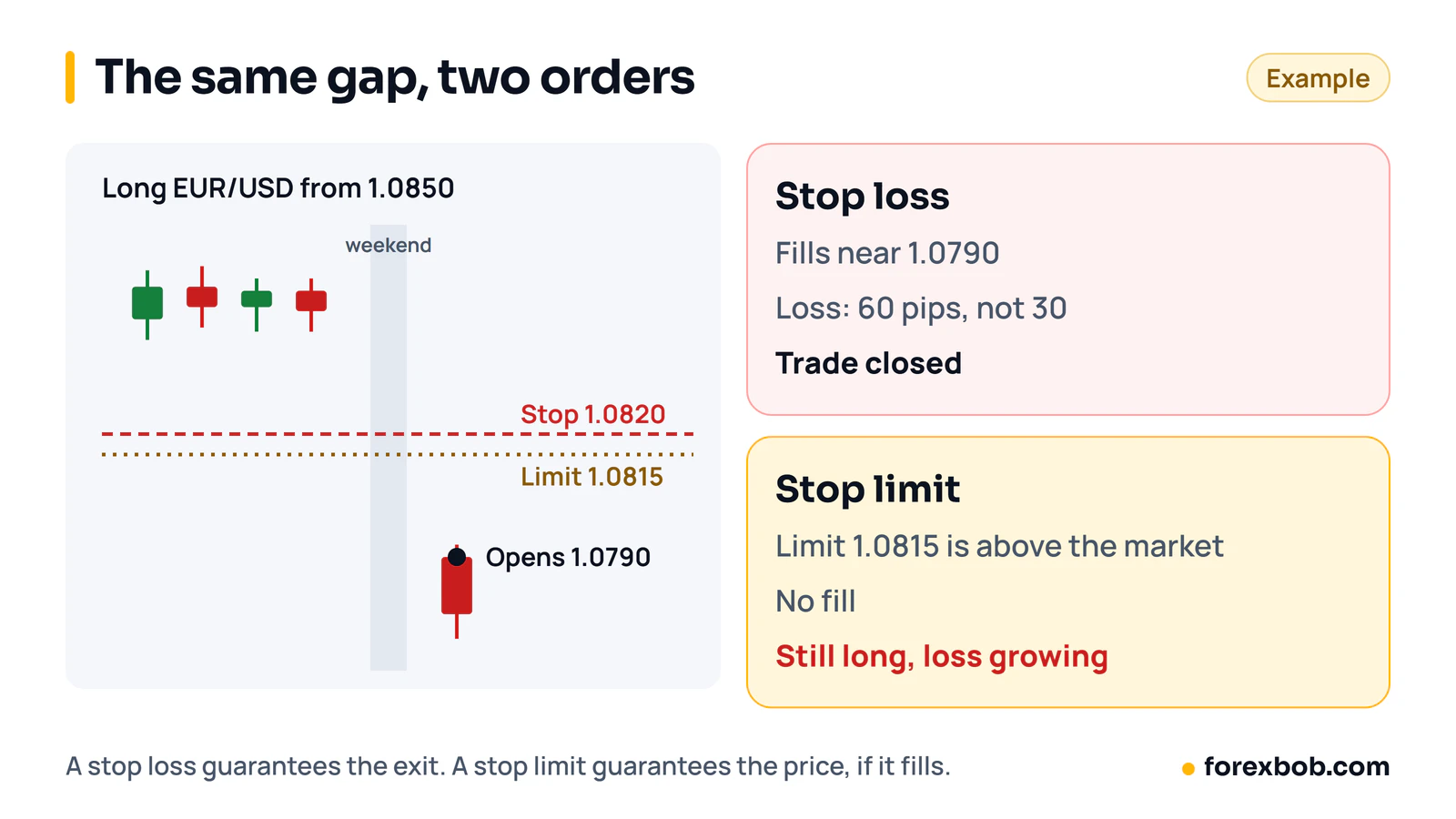
For most retail traders the stop loss is the safer default. A bad fill costs you a known-ish amount. An unfilled stop can cost you anything.
Which one MetaTrader uses
In MT4 and MT5 the stop loss you attach to a position is a stop market order. It closes at the next available price once triggered, so on a gap it fills at the gap price. There is no stop limit version of a position's stop loss.
MT5 does have Buy Stop Limit and Sell Stop Limit pending orders, but they are for entries. A Buy Stop Limit waits for price to rise to the stop price, then places a Buy Limit at a lower price, so you enter on the pullback after a breakout rather than at the top of the spike.
Stock and crypto platforms often offer stop limit exits. If yours does, set the limit far enough from the stop that ordinary fast moves still fill, or the protection is mostly on paper.
Trailing stop vs trailing stop limit
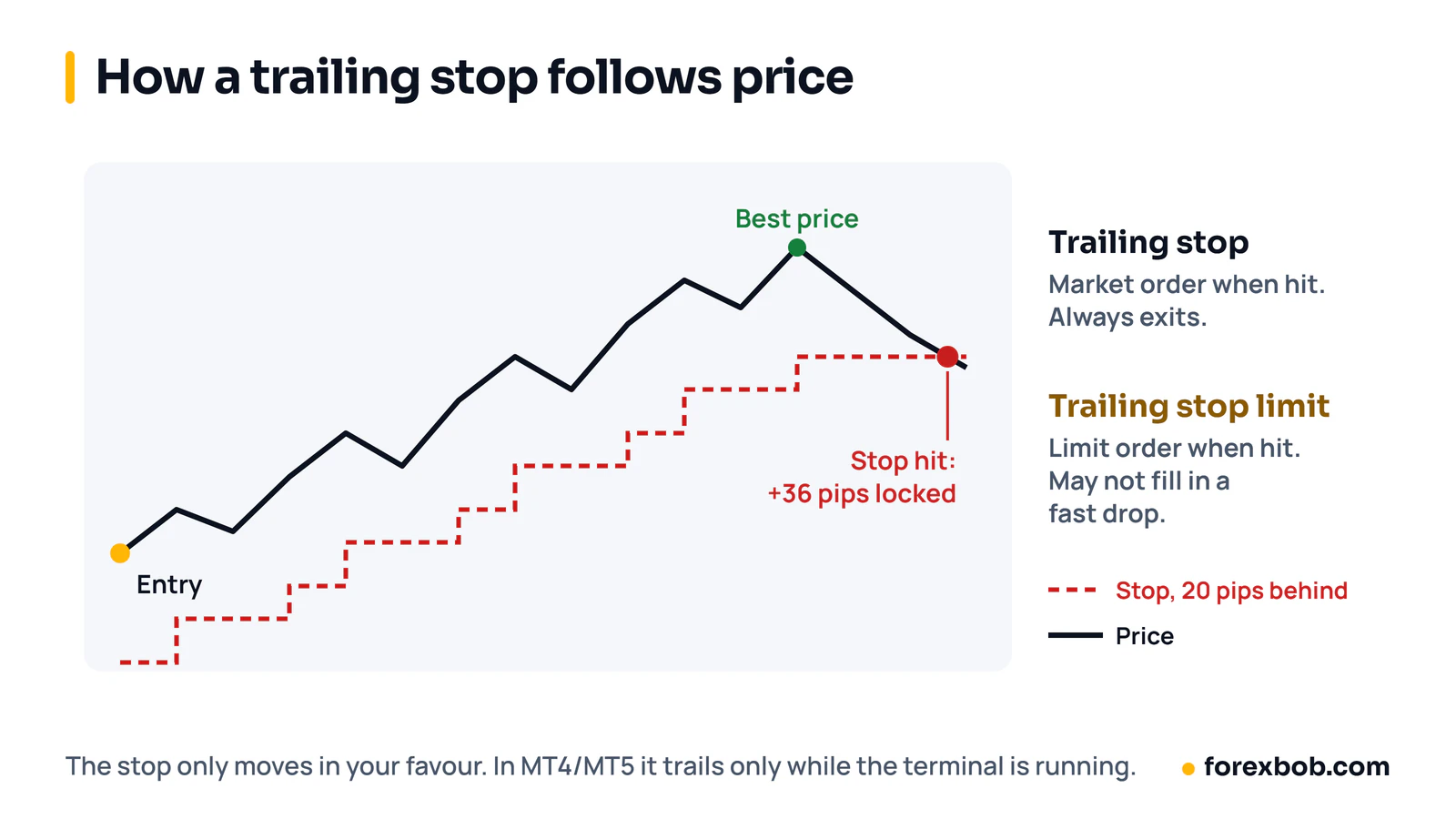
A trailing stop follows price when it moves in your favour and stays put when it moves against you. With a 20-pip trail on a long trade, every new high pulls the stop up to 20 pips below that high. When price falls back 20 pips from its best level, the stop triggers.
A trailing stop limit works the same way, but when it triggers it places a limit order instead of a market order. You set the trail distance and a limit offset, for example trail 20 pips, limit 3 pips below the stop. Same trade-off as before: a better price if it fills, and a chance that it doesn't.
The MetaTrader trailing stop catch
The built-in trailing stop in MT4 and MT5 (right-click a position, Trailing stop) runs in your terminal, not on the broker's server. If you close MetaTrader or your computer goes to sleep, the stop stops trailing. It stays wherever it last moved to.
That is one reason traders who use trailing stops overnight run their platform on a VPS, or use an EA that moves the stop with a real order modification each time.
Testing a trailing stop properly
Trailing stops are easy to fool yourself with in a backtest. We tested a gold scalping EA that trailed its stop. On one-minute bars it showed an average win of $2.46. On real tick data over the same period the average win was $1.34, and the strategy went from profitable to losing.
The reason: with bar data, the test can only move the trail once per bar, so it never sees price tighten the stop and then reverse into it within the same minute. Real markets do that all the time. If your plan uses a trailing stop or a breakeven move, test it on tick data. Our MT5 Strategy Tester guide shows where that setting is.
Which to use
- For most forex trades: a normal stop loss. You accept some slippage in return for a guaranteed exit.
- When a gap would be worse than the loss: reduce size before weekends and big news rather than switching to a stop limit.
- For entries after a breakout: a stop limit (Buy Stop Limit or Sell Stop Limit in MT5) can stop you buying the top of a spike.
- For trailing exits: a trailing stop, run on a VPS or by an EA, and tested on tick data.
Wherever you put the stop, size the trade so that hitting it costs the amount you planned. The calculator below does the sum. Our guide on where to place a stop loss covers choosing the level.
Keep reading: where to place a stop loss, forex risk management, the position size calculator and MT5 Strategy Tester guide.
Risk note: trading forex carries a high level of risk and may not be suitable for everyone. This article is for education only and is not financial advice.
Position size
0.40 lots
40,000 units
Amount at risk
$100.00
Pip value (1 lot)
$10.00
Mini lots
4.0
Micro lots
40
Have a strategy you want automated?
We turn trading rules into tested Expert Advisors for MT4 and MT5. Tell us how you trade and we'll send a specification and a quote.
More articles

Supply and demand trading: how to mark zones, and what testing shows
How to find supply and demand zones, draw them, enter and place stops. Then what happened when we tested a zone strategy on seven years of EUR/USD.
Read article
Forex risk management: the complete guide
Everything that decides how much you can lose, in one place: risk per trade, sizing, stops, leverage, correlated trades, drawdown limits and the extra risks of EAs.
Read article
Forex prop firms explained: funded accounts, the rules and using EAs
What prop trading is, how forex funded account challenges work, the drawdown rules that end most attempts, what firms allow with EAs, and the maths behind passing.
Read article