
What is profit factor in trading? Formula and good values
How to calculate profit factor, how it links win rate and win size, what counts as a good value, four checks before you trust one, and where MT5 and MT4 show it.

Profit factor is gross profit divided by gross loss. Add up every winning trade, add up every losing trade, and divide the first total by the second. Above 1, the trades made money over that period; below 1, they lost it. In a backtest with a few hundred trades and realistic costs, a value between about 1.3 and 2 is worth taking further, and anything far above that needs checking before you believe it.
It is one of the first numbers in the MT5 Strategy Tester report and on most EA sales pages, so it pays to know what it can and can't tell you.
The profit factor formula
Profit factor = gross profit ÷ gross loss
Gross profit is the total of all winning trades. Gross loss is the total of all losing trades, counted as a positive number. Breakeven trades add nothing to either side.
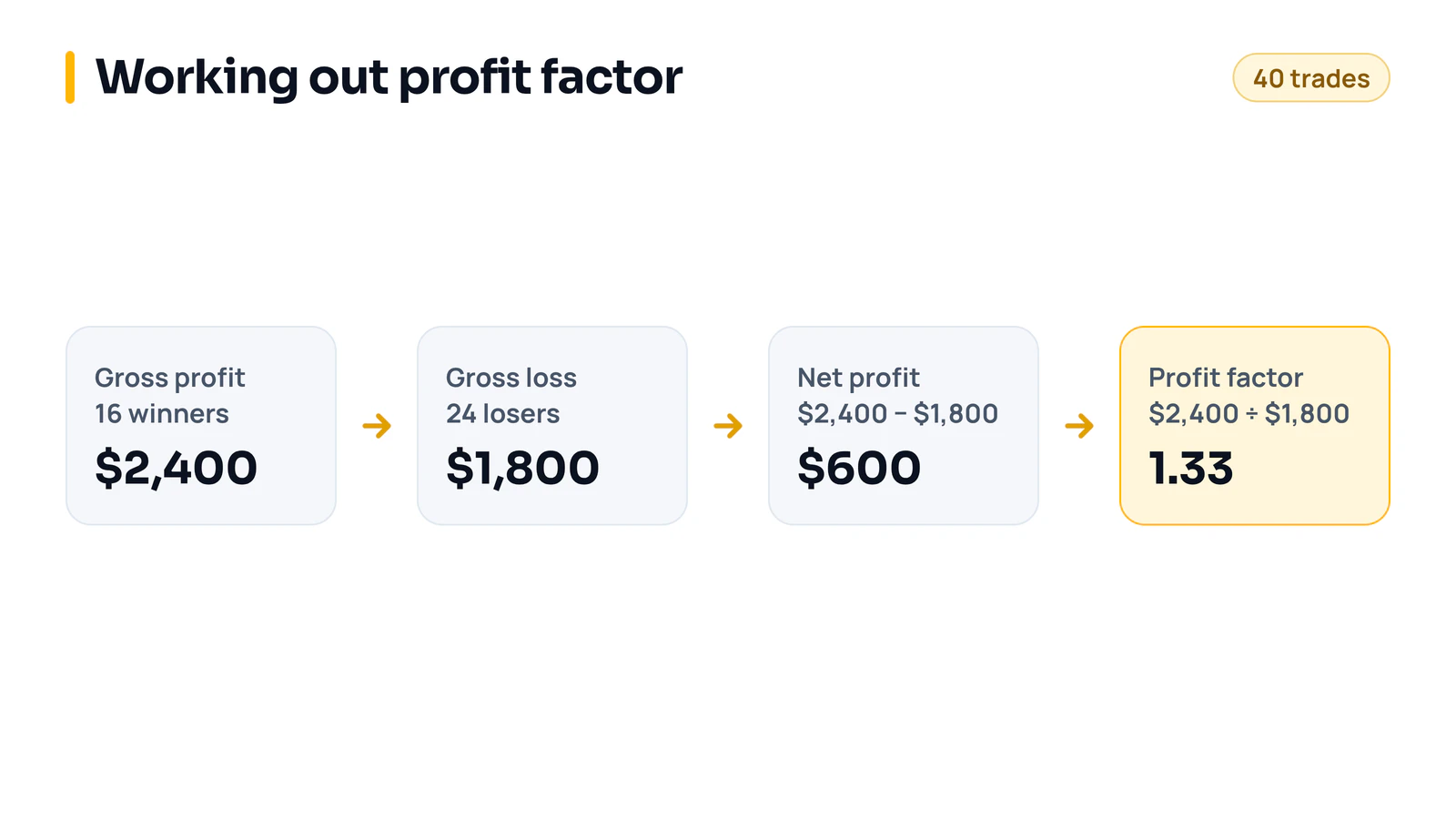
Say 40 trades produced 16 winners that made $2,400 between them and 24 losers that lost $1,800. The profit factor is $2,400 ÷ $1,800 = 1.33. Net profit is $600, or $15 a trade.
You can do the same sum in R (multiples of your risk) instead of money, which keeps results comparable when your balance or risk per trade changes. In a spreadsheet with one trade result per row in column F, the formula is =SUMIF(F:F,">0")/-SUMIF(F:F,"<0").
Profit factor, win rate and win size
Profit factor puts how often you win and how big the wins are into one number:
Profit factor = (win rate × average win) ÷ (loss rate × average loss)
Very different strategies can end up with the same value. Winning 40% of the time with wins twice the size of the losses gives 1.33, the same as the example above. Winning 70% of the time with wins half the size of the losses gives 1.17. At a 50% win rate, the wins have to be bigger than the losses just to get above 1.
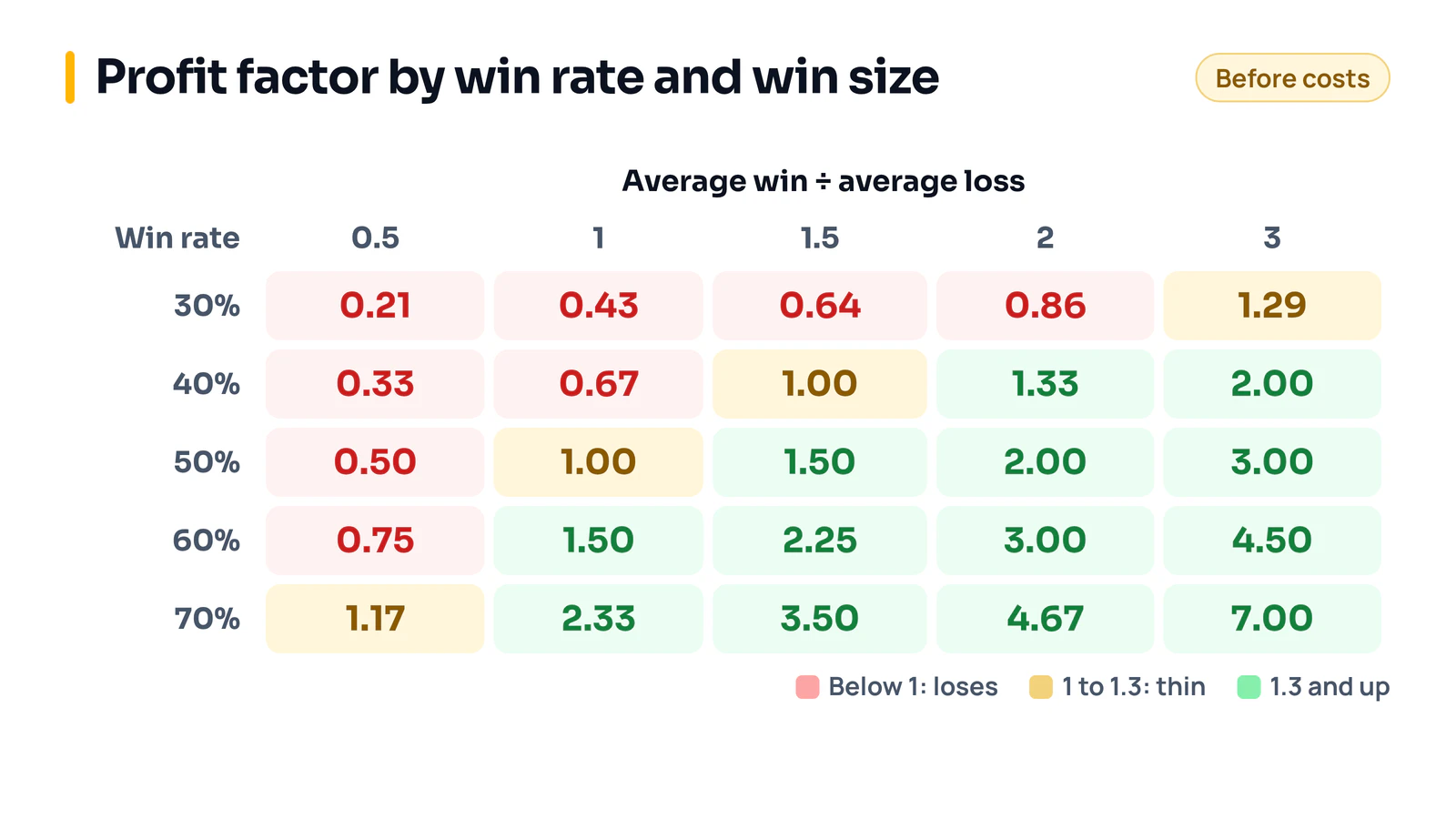
Our article on risk-reward ratio vs win rate looks at the same trade-off through expectancy. Expectancy is what one trade makes on average. Profit factor is how many dollars the winners made for every dollar the losers cost. Look at both: a profit factor of 1.5 built from tiny average trades is fragile, because a slightly wider spread or a little slippage can take most of it.
What is a good profit factor?
There is no official scale. This is how we read it, for a backtest with realistic costs and a few hundred trades:
- Below 1: the strategy lost money in that test.
- 1 to 1.3: thin. Slightly higher costs, worse fills or a change in the market can push it under 1.
- 1.3 to 2: worth taking further, into out-of-sample tests and a demo account.
- Above 2: possible, especially for strategies that trade rarely. Check the trade count and the drawdown first.
- Above 3 or 4 on hundreds of trades: check the test itself before anything else. Optimised settings, costs that are too low and losing trades left open all produce numbers like these.
Our own test of an order block strategy on gold shows why the number needs context. On the 15-minute chart it made a profit factor of 1.13 over 80 trades, but its worst drawdown of 14.1R was bigger than the 8.9R it made in total. On the hourly chart the same rules made 0.64 over 23 trades. The details are in our article on order block trading.
How to check a profit factor before you trust it
Run these four checks on any profit factor, from your own backtest or from a sales page:
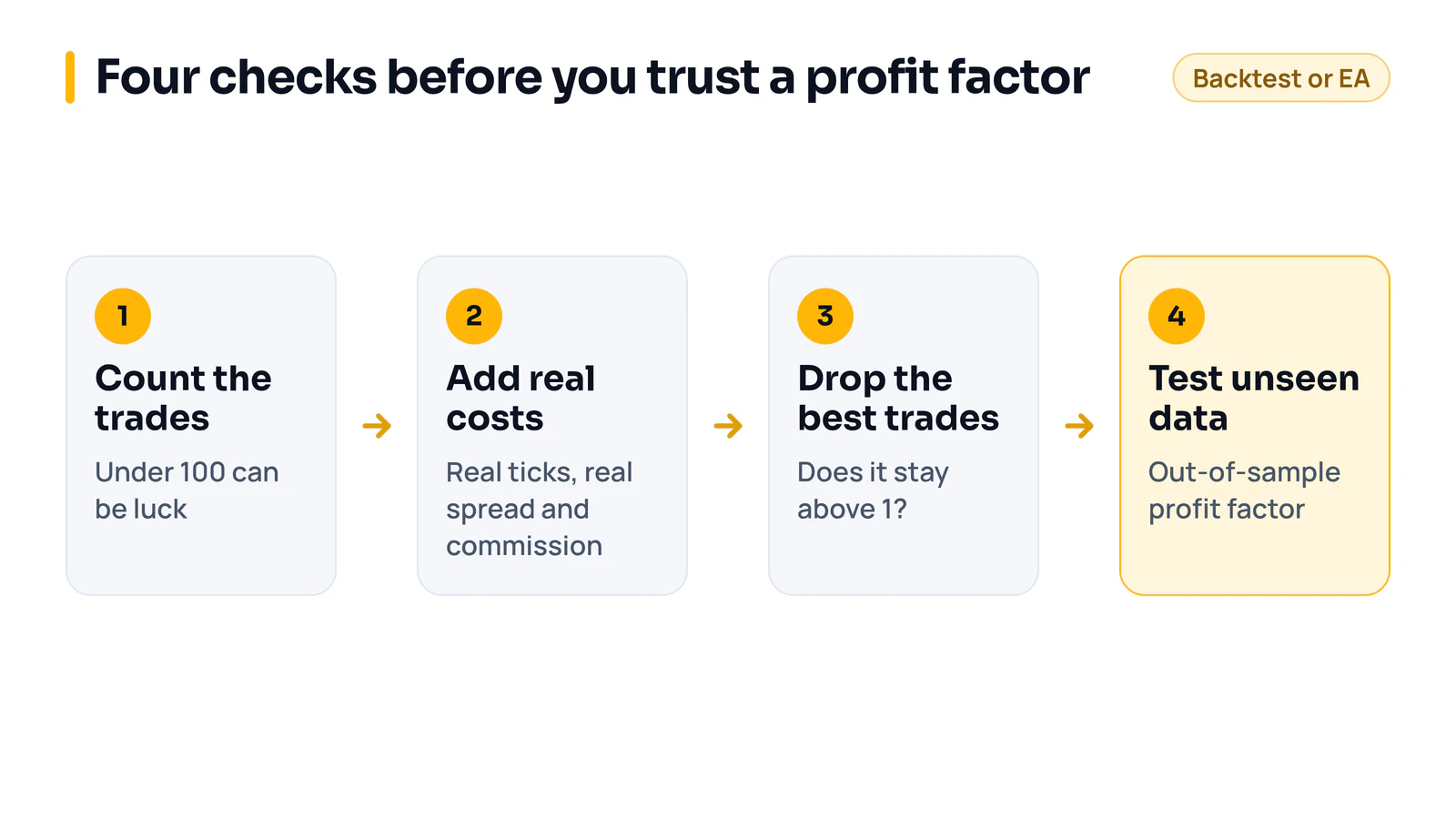
1. Count the trades
Under 100 trades, the profit factor can easily be luck. Look for hundreds of trades over several years, with at least one strong trend and one quiet range in them.
Be careful when you sort optimisation results in MT5 by profit factor (the Profit Factor max criterion). The top rows tend to be settings that took very few trades, because a handful of lucky wins and almost no losses make a huge ratio.
2. Test with real costs
Spread, commission and swap come off every trade. A test with a fixed low spread, or a trailing-stop strategy tested on one-minute bars, can show a profit factor the strategy never reaches live. Our MT5 Strategy Tester guide shows a gold scalper that was profitable on bar data and lost money on real ticks.
3. Drop the best trades
Take out the single best trade and work the profit factor out again. In the 40-trade example, if the best winner made $700, the other 15 made $1,700, and the profit factor without it is $1,700 ÷ $1,800 = 0.94. A record that falls below 1 without one trade has no edge you can count on yet.
4. Compare it on unseen data
If the settings were optimised, the in-sample profit factor is the best case by design. Run the same settings on a period they were never tuned on. Some drop is normal. A drop below 1 means the optimisation found noise. A walk-forward optimization repeats this check over many periods.
What profit factor doesn't show
Profit factor counts closed trades only. A grid or martingale EA that closes its winners quickly and leaves losing positions open can show a very high profit factor while the account's equity is deep underwater. Our article on grid and martingale EA risks explains how these systems work and where they fail.
It also ignores the order of the trades. Two strategies with the same profit factor can have very different drawdowns if one spreads its losses out and the other takes them in one long streak. Read the profit factor next to the maximum equity drawdown and the number of trades. For an EA you're thinking of buying, our guide on how to judge an Expert Advisor lists what else to check.
When we test an EA, our own or a commercial one we've rebuilt, we read the profit factor next to the trade count and the maximum equity drawdown. We only take it seriously once the test has run on real ticks with realistic spread and commission.
Where to find profit factor in MT5 and MT4
- MT5 Strategy Tester: after a run, open the Backtest tab. Profit Factor is listed with Gross Profit, Gross Loss and Expected Payoff.
- MT4 Strategy Tester: it's on the Report tab.
- Your MT5 account history: open View, Reports.
- Your MT4 account history: right-click in the Account History tab and choose Save as Detailed Report.
- Your own records: use the spreadsheet formula above on the results column of your trading journal.
FAQ
What does a profit factor of 2 mean?
The winning trades made $2 for every $1 the losing trades cost, so net profit equals the gross loss. With $5,000 of gross loss, that's $10,000 of gross profit and $5,000 net.
Is a profit factor of 1.5 good?
In a backtest with a few hundred trades, real-tick data and realistic costs, it's a solid result worth testing further. On 40 trades, or on settings optimised over the same data, it doesn't tell you much yet.
Can a profit factor be too high?
A very high value is a reason to check the test. Above 3 or 4 over hundreds of trades, look for optimised settings, costs that are too low or losing trades left open. A strategy that trades rarely can reach high values honestly, but then the trade count is small.
Which matters more, profit factor or win rate?
Profit factor, because it already includes the win rate along with the size of the wins and losses. A win rate on its own can't tell you whether a strategy makes money: winning 60% of the time with wins half the size of the losses gives a profit factor of 0.75.
Keep reading: the MT5 Strategy Tester guide, risk-reward ratio vs win rate, how to judge an Expert Advisor and walk-forward optimization.
Risk note: trading forex carries a high level of risk and may not be suitable for everyone. This article is for education only and is not financial advice.
Have a strategy you want automated?
We turn trading rules into tested Expert Advisors for MT4 and MT5. Tell us how you trade and we'll send a specification and a quote.
More articles

ATR stop loss: how to set it and which multiplier to use
How an ATR stop loss works, how to read the ATR in MT5 and turn it into pips, which multiplier to start with, how to size the trade, and how to trail it.
Read article
Walk-forward optimization: how to run it in MT5
How walk-forward optimization works, how to pick the window lengths, how to run it window by window in MT5, and what the results can and cannot tell you.
Read article
How to install an Expert Advisor in MT5 and MT4
Where the EA file goes, how to attach it to a chart, which switches must be on, and what to check when an installed EA still does not trade.
Read article